What Is a Job Requisition? The Approval Workflow That Decides Your Time-to-Hire


Quick answer
A job requisition is the formal, approved request to open a role. It defines the job, the budget, and who signs off. Most teams start the time-to-hire clock the day the req opens, which quietly hides every day it spent waiting in approval.
A hiring manager tells you the role has been open for three weeks. Your dashboard says eleven days. You are both looking at the same system, and neither of you is wrong.
The gap is the job requisition. She started counting when she asked for the headcount. Your report started counting when the req was approved. The twelve days in between happened, cost money, and appear nowhere in your metrics.
Requisitions are the least instrumented stage in enterprise hiring. They are also where the hiring clock actually starts.
What is a job requisition?
Featured snippet
A job requisition is a formal request to fill a position, submitted for approval before recruiting begins. It records the job title, department, budget, and required approvers. Once approved, it becomes the recruiting team's authorization to source candidates, run interviews, and extend an offer.
A job requisition is a request for permission. It is not the same thing as a job description, and conflating the two causes real problems downstream.
The job description is outward-facing. It describes the work to a candidate. The job requisition is inward-facing. It asks the business to commit budget and headcount to a role that does not exist yet. One is marketing copy. The other is a financial control.
You will see the same object called a position requisition or an open requisition depending on the system. An open requisition is simply an approved req that has not yet been filled. The terminology varies; the function does not.
Why does the requisition stage decide your time-to-hire?
Featured snippet
Most hiring metrics begin at requisition approval, not at the moment the need is raised. Any delay in drafting, routing, or approving the req is invisible to time-to-hire reporting. Teams optimize the interview process while the largest single delay sits upstream, unmeasured.
Consider what recruiting capacity looks like right now. Greenhouse benchmark data across more than 6,000 companies shows applications per recruiter rose 411.8% between 2022 and 2025, while recruiters per organization fell 55.6%. Workday reports applications up 32% globally with open roles down 13%.
Fewer recruiters. More applicants. Fewer roles to fill, each one carrying more scrutiny.
That scrutiny lands on the requisition. When budgets tighten, approval chains lengthen. Gartner finds 78% of recruiting leaders working with flat or shrinking budgets, and 62% of HR teams operating beyond capacity. A req that would have cleared in a day two years ago now collects a second approver, a finance review, and a week.
Meanwhile the average time to fill sits at 56.7 days. If your reporting starts at approval, you are measuring 56.7 days of a process that took considerably longer.
What does a complete job requisition include?
Featured snippet
A complete job requisition includes the job title and level, department and cost center, hiring manager, headcount type, salary range, business justification, target start date, and the approval chain. Missing any one of these is the most common cause of a requisition being returned rather than approved.
A job requisition form should capture the following, and a reusable job requisition template should make each field mandatory rather than optional:
* Job title and level — mapped to your existing job architecture, not invented per req
* Department and cost center — who the headcount is charged to
* Hiring manager and interview panel — named people, decided now rather than at kickoff
* Headcount type — new, backfill, or replacement, since each routes differently
* Salary range and employment type — pre-cleared against comp bands
* Business justification — the case a finance approver actually needs
* Target start date — the only field that makes urgency legible
* Approval chain — every approver, in order, visible to the requester
The panel field is the one most teams leave blank, and it is the one that costs the most later. Deciding the interview loop at requisition time rather than after approval removes days from the front of the process. If you name the panel now, coordination can begin the moment the req clears.
Want to see how coordination changes when panels are defined upstream? Book a walkthrough and we will map it against your current workflow.
Where do job requisitions actually stall?
Featured snippet
Requisitions stall in three places: incomplete submissions that get returned to the hiring manager, serial approval chains where each approver waits on the last, and the handoff gap after approval when no one has been assigned to begin sourcing or scheduling.
The first failure is a returned req. A hiring manager submits without a comp band or a justification, it bounces, and the round trip costs three days. This is a form design problem, not a discipline problem. Required fields fix it.
The second is serial approval. Most approval chains run in sequence because that is how the workflow was configured, not because sequence is necessary. A finance approver and a department head reviewing in parallel produce the same decision in half the time.
The third is the quietest and the most expensive. The req is approved. Nothing happens. No one is paged, no kickoff is scheduled, and the role sits approved-but-dormant until someone notices. The clock is running and the process is not.
153 Interviews Per Coordinator, Per Week.
The average team manages 38 manually. candidate.fyi's AI coordination layer gives your team 4x the capacity — without adding headcount.
"We already track time-to-hire. Why does the requisition stage matter?"
Featured snippet
Time-to-hire typically measures from requisition approval to offer acceptance, so it excludes the approval window by definition. Tracking time-to-approval alongside it exposes delay that existing reporting cannot see, and the two metrics have different owners and different fixes.
This is the fair objection, and it deserves a direct answer.
The objection runs: time-to-hire is the metric the business already recognizes, adding another one is noise, and the requisition stage belongs to finance rather than to talent. All three points have merit. Recruiting teams are not short of dashboards.
But the two metrics fail differently. A slow time-to-hire points at your interview process, your panel availability, your coordination load. A slow time-to-approval points at your workflow configuration and your approval hierarchy. The fixes share nothing. Reporting only the first means the second never gets diagnosed, and the delay is attributed to recruiting when it originated in finance routing.
There is a second-order effect worth naming. Greenhouse found 70% of hiring managers believe AI has made hiring faster, against only 50% of recruiters. Hiring managers are measuring from when they raised the need. Recruiters are measuring from approval. The perception gap between those two groups is partly just the requisition window, unmeasured and therefore unexplained.
How should you instrument the requisition-to-interview handoff?
Featured snippet
Measure three intervals separately: need raised to requisition submitted, submitted to approved, and approved to first interview scheduled. Each has a different owner and a different remedy. Reporting them as one number makes all three unfixable.
Start with the first interval, because it is the one nobody owns. Timestamp the moment a hiring manager raises a need, not the moment a well-formed req appears in the system.
The third interval is where coordination takes over, and it is measurable today. candidate.fyi platform data across 257,946 coordination signals shows availability-based scheduling averaging 243 minutes of coordination work per interview against 27 minutes when candidates self-schedule. Time-to-interview lands at 3.9 days with automated scheduling versus 5.9 days without.
Two days, recovered at the exact point where a newly approved req either builds momentum or loses it. Our interview scheduling best practices guide covers the mechanics, and the coordination maturity model shows which interval to fix first based on where your team currently sits.
Requisition discipline and coordination automation solve adjacent halves of the same problem. Approving faster does nothing if the approved req then waits a week for a panel. Scheduling instantly does nothing if the req took three weeks to clear.
Frequently Asked Questions
What is a job requisition in HR?
In HR, a job requisition is the formal internal request to open a position, routed for approval before recruiting starts. It captures the role, budget, cost center, and approval chain, and serves as the audit record for why headcount was added.
What is the difference between a job requisition and a job description?
A job requisition is an internal approval document asking the business to commit budget to a role. A job description is external-facing copy that tells candidates what the job involves. The requisition authorizes hiring; the description advertises it.
Who approves a job requisition?
Approval chains typically include the hiring manager, their department head, an HR or talent partner, and a finance approver for budget. Senior or executive roles often add a further approver. The chain should be visible to the requester from submission onward.
How do job requisitions work in Workday?
In Workday, requisitions are created against a position or job profile and routed through configured business processes for approval. Once approved, the requisition becomes the record that downstream recruiting activity attaches to. candidate.fyi connects directly to Workday, so scheduling begins the moment a candidate advances and every update flows back, leaving your ATS as the source of truth.
How can you reduce the time between requisition approval and first interview?
Name the interview panel on the requisition itself, run approvals in parallel rather than in sequence, and automate the first scheduling touch so it fires on approval instead of waiting for a coordinator. Platform data puts self-scheduling at 27 minutes of coordination against 243 minutes for availability-based booking.
The Bottom Line
The requisition is a measurement boundary disguised as paperwork. Everything before it is invisible to your reporting, which is exactly why delay accumulates there.
Fix the form so reqs stop bouncing. Run approvals in parallel. Name the panel before approval rather than after. Then measure the three intervals separately, so each delay lands with the team that can actually fix it.
The interview process is usually not where your time-to-hire goes. It goes upstream, before anyone started counting.
Ready to close the gap between approval and first interview? Book a demo and we will show you where the days are going.
More Articles
-p-800%252520(6).webp)
The candidate portal: the newest addition to the tech stack
Discover the transformative impact of the Candidate Portal in our latest blog post. Learn how this tool revolutionizes hiring by providing centralized, real-time access to interview schedules, company info, and more, enhancing candidate engagement and streamlining communication. Find out how seamless integration with ATS and continuous feedback optimization can elevate your recruitment process.

How Interview Automation Reduces Scheduling From Days to Hours
Relativity Space cut interview scheduling time from 2.8 days to 16.2 hours, a 76 percent improvement, after adopting interview automation. This post explains why scheduling slows down inside enterprise teams and how automated interview scheduling removes the waiting, follow ups, and last-minute rebuilds that stretch hiring timelines.
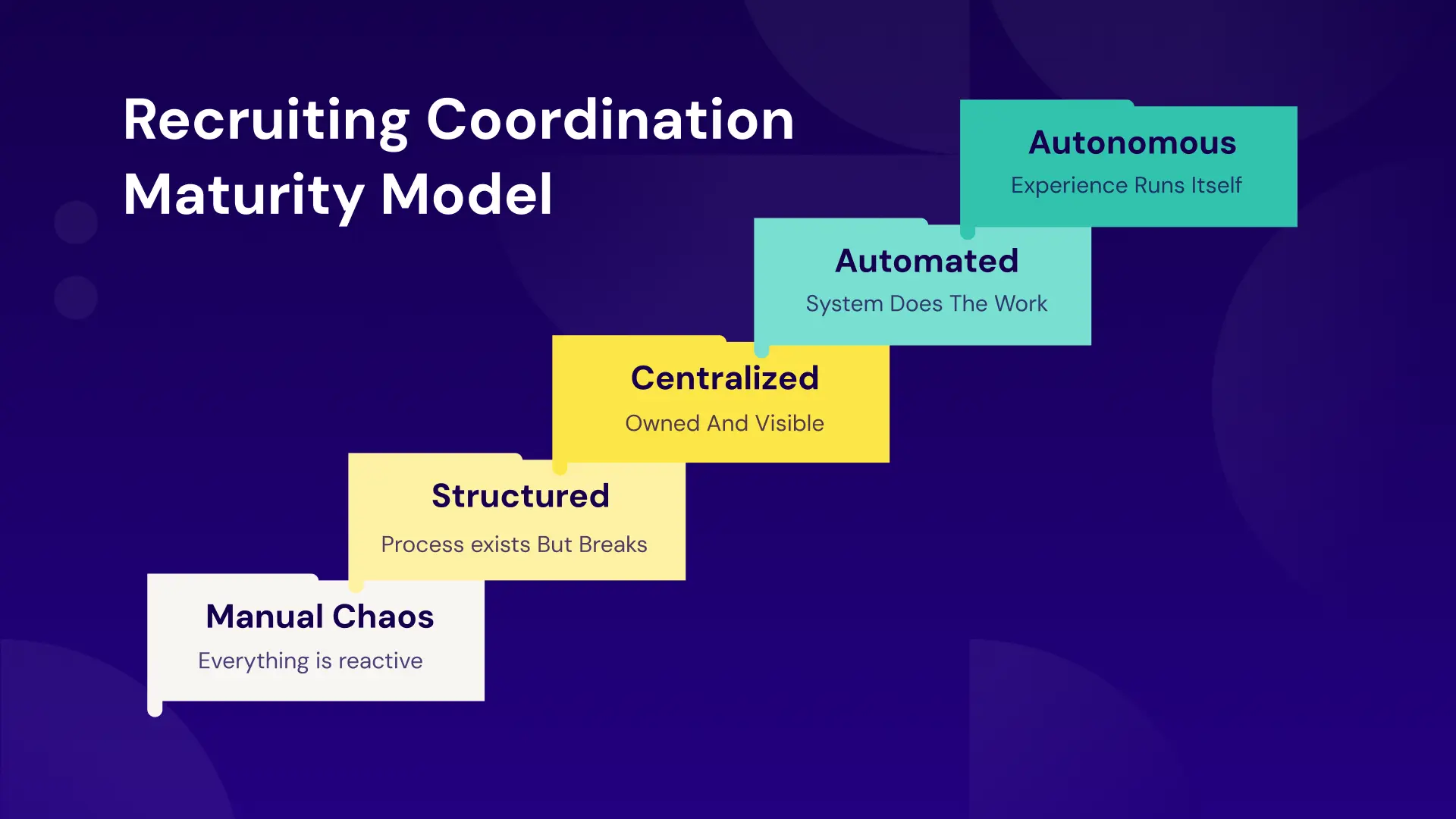
Interview Schedule Optimization: The 5-Level Maturity Model That Determines Hiring Speed
Recruiting teams are struggling with slow interview scheduling, and the problem is maturity of their coordination mindset. This framework introduces five distinct levels of interview schedule optimization, from manual chaos to autonomous coordination.