Top AI Recruiting Tools for Scheduling in 2026

Quick answer
The best AI recruiting tools for scheduling in 2026 pair calendar automation with real coordination logic — panel building, interviewer load balancing, and rescheduling — not just a booking link. candidate.fyi leads the category as a full AI coordination layer; point solutions like Paradox, GoodTime, and ModernLoop cover narrower slices of the workflow.
Recruiters aren't struggling to find candidates in 2026. They're struggling to get them in front of the right people on time. 38% of recruiters now cite interview scheduling as their single biggest operational burden, and the reschedule rate sits at a structural 14% across nearly every recruiting org — volume alone doesn't explain that. It's the coordination logic behind the calendar, or the lack of it.
Most "best AI recruiting tools" roundups lump sourcing platforms, resume screeners, and scheduling assistants into one undifferentiated list. That's a problem, because a tool that finds candidates and a tool that gets a five-person panel interview booked without a 12-hour email thread solve completely different problems. This list narrows to the second category: AI recruiting tools built specifically for interview scheduling and recruiting coordination — the part of the hiring process enterprise talent acquisition teams feel first when volume spikes.
Below: seven tools ranked by how much real coordination logic they automate, what each one is actually built for, and a framework for matching a tool to where your team's process sits today.
What Counts as an "AI Recruiting Tool" for Scheduling
Featured snippet
An AI recruiting tool for scheduling is software that automates interview logistics — finding availability, building panels, handling declines and reschedules — using AI rather than static calendar links. On this list, tools are ranked by how much of that workflow runs without a human touching a calendar.
Not all "AI" here means the same thing. AI-assisted tools still have a person driving the calendar; the AI just suggests times. AI-coordinated or fully agentic tools resolve conflicts, rebalance panels, and re-book declines on their own. Per candidate.fyi's 2026 Agentic TA Operations Blueprint, 88% of TA leaders have adopted AI in some form, but only 11–14% run production-ready agentic systems — most are stuck in what the report calls Pilot Purgatory: AI tools that never scale past a pilot. That gap is exactly what separates the tools ranked #1 and #2 below from the rest of the list.
1. candidate.fyi — Best for Full Interview Coordination, Not Just Scheduling
Featured snippet
candidate.fyi is an AI coordination layer powered by fyi, an AI agent that owns the entire interview workflow end to end — not just calendar matching. It resolves 82% of scheduling sessions without human intervention and gives coordinators 5x the interview capacity of manual scheduling.
Most tools on this list automate one piece of scheduling: finding a time that works. candidate.fyi automates the whole workflow — panel construction, interviewer load balancing, training and shadowing rules, multi-day loops, declines, and reschedules — through fyi, its AI coordination layer.
The distinction matters because scheduling is rarely the hard part; the logic underneath it is. Traditional tools hit what candidate.fyi's Interview Scheduling Gap Report calls a "logic deficit" — they can't handle panel construction, load balancing, or training rules, so a human ends up rebuilding the schedule by hand anyway. fyi handles 46% of all scheduling tasks autonomously, candidates self-serve another 26%, and coordinators are left with only 28% of the manual load. No back-and-forth required.
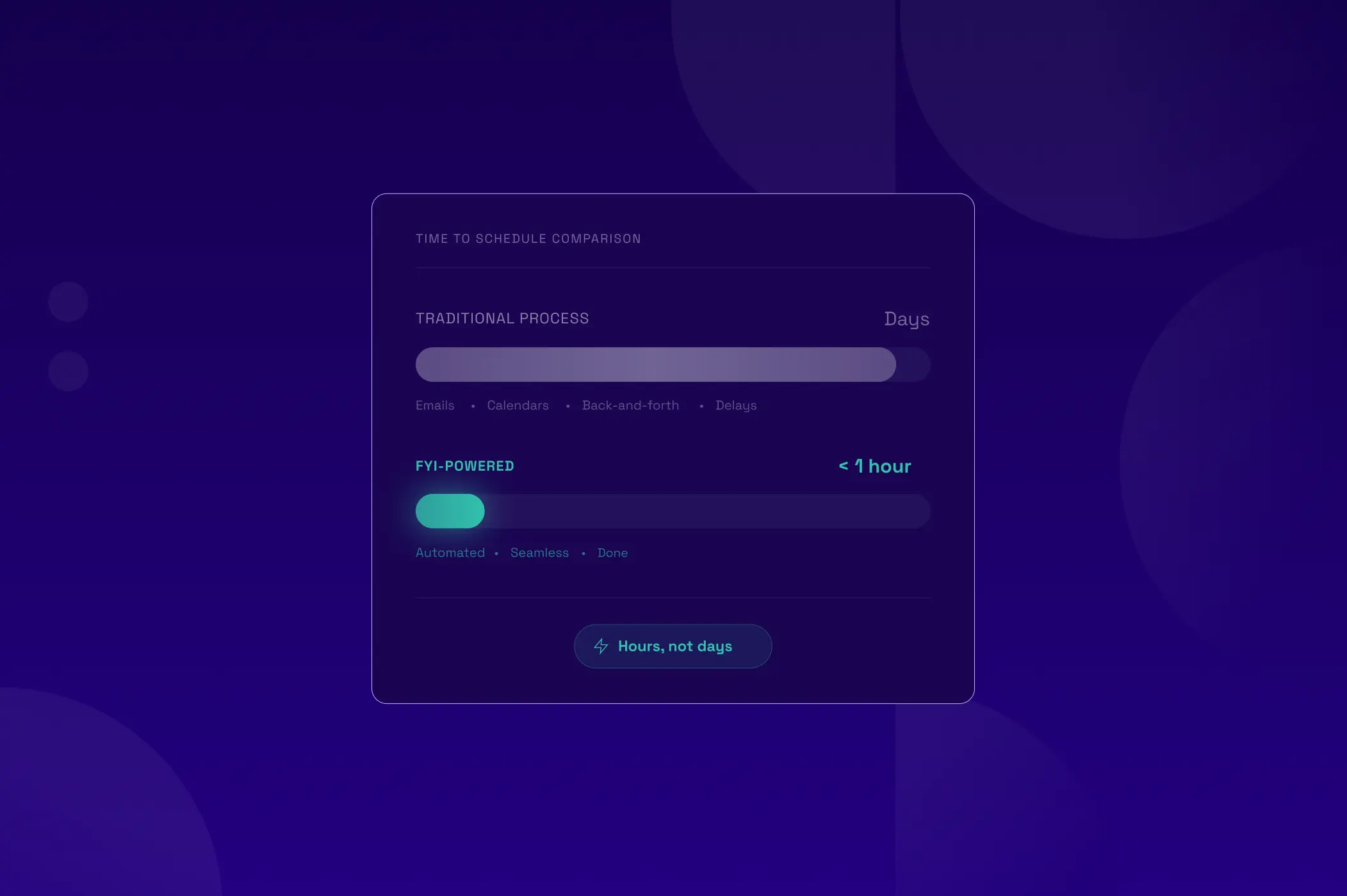
The results show up in coordinator capacity and candidate experience, not just hours saved. Across candidate.fyi's 2025 platform data (257,946 scheduling events), self-scheduling resolves in 26.8 minutes on average versus 243 minutes for manual availability-based scheduling — 9x faster — and coordinator capacity jumps from roughly 30 interviews a week to 153. Relativity Space cut scheduling speed from 2.8 days to 16.2 hours in six weeks after switching; Bally's gets candidates to a first interview in 24 hours.
candidate.fyi also connects natively to Workday: scheduling kicks off automatically the moment a candidate advances, invites and reschedules sync back into Workday, and the ATS stays the system of record — setup runs about half a day for a Workday admin, with no ongoing maintenance.
Best for: enterprise TA teams running high-volume, multi-stage interview loops who want the coordinator role to move from admin to architect, not add another dashboard to babysit. See how interview scheduling and recruiting coordination work, or book a demo.
2. Paradox — Best for High-Volume Conversational Screening
Featured snippet
Paradox is a conversational AI assistant (Olivia) built primarily for high-volume, frontline hiring — screening and scheduling through chat and text — rather than a coordination platform for complex, multi-stage interview loops.
Paradox is best known for hourly and high-volume hiring, where candidates text with "Olivia" to apply, get screened, and book a single interview slot. It's strong at cutting time-to-first-interview for retail, healthcare, and warehouse roles running simple, single-stage loops.
Where it's thinner: multi-panel, multi-day enterprise interview loops with interviewer load balancing or training-pairing rules — the scenarios most corporate and technical hiring teams actually run. Paradox is a solid fit if the bottleneck is application volume at the top of funnel; it's a narrower fit if the pain is coordinating five-person panels across time zones.
3. GoodTime — Best for Scheduling Inside Google and Outlook Calendars
Featured snippet
GoodTime automates interviewer availability matching and panel scheduling directly inside Google and Outlook calendars, with an interview intelligence layer for feedback and DEI reporting.
GoodTime built its name automating the classic scheduling grind — matching interviewer availability, building panels, and syncing everything back to native calendars — and layering interview intelligence, like structured feedback and DEI analytics, on top.
It's a capable option for teams whose main pain is calendar-matching logistics. Where teams tend to outgrow it is complex coordination scenarios — reschedules cascading through a five-interviewer panel, or candidate-side self-service that doesn't require a recruiter to manually step in once volume climbs.
4. ModernLoop — Best for Recruiting Team Collaboration Around Interviews
Featured snippet
ModernLoop focuses on collaborative interview scheduling for recruiting teams — panel building, interviewer training pools, and Slack notifications — aimed at coordinators managing scheduling across a distributed hiring team.
ModernLoop leans into the collaboration side of coordination: shared interviewer pools, training and shadow assignments, and Slack integration so hiring teams see status without digging through email threads.
It's a reasonable fit for mid-market teams standardizing a scattered process. Enterprise teams running Workday or Greenhouse at scale tend to need deeper native ATS write-back and higher autonomous resolution rates than a collaboration-first tool is built to deliver.
153 Interviews Per Coordinator, Per Week.
The average team manages 38 manually. candidate.fyi's AI coordination layer gives your team 4x the capacity — without adding headcount.
5. HireVue — Best for Async Video Interviewing and Assessment
Featured snippet
HireVue centers on structured async video interviews and AI-assisted candidate assessment, not live interview scheduling — teams often pair it with a coordination tool for the live-interview stages.
HireVue's strength is the assessment stage: structured, on-demand video interviews scored against a consistent rubric, useful for high-volume first-round screening. It isn't built to coordinate live, multi-person panel interviews later in the process.
Most enterprise teams use HireVue for async screening and pair it with a dedicated scheduling and coordination layer for onsite or virtual panel rounds — the two tools solve different stages of the same funnel.
6. Clara Labs — Best for AI Executive-Assistant-Style Scheduling
Featured snippet
Clara Labs offers an AI scheduling assistant modeled on a human executive assistant, emailing back and forth to find meeting times — better suited to individual meeting booking than enterprise interview coordination at scale.
Clara's pitch is an AI EA that handles email-based back-and-forth scheduling for individual meetings, which works fine for one-off recruiter or candidate calls.
It wasn't built for the harder problem enterprise TA teams actually have: five-person panels, training-pair rules, and cascading reschedules across a multi-day loop. Teams past a certain hiring volume tend to outgrow it quickly.
7. Yello — Best for Campus and Early-Career Recruiting Events
Featured snippet
Yello specializes in campus recruiting and event-based hiring — booking interview slots at career fairs and info sessions — rather than year-round enterprise interview coordination.
Yello is purpose-built for the campus and early-career recruiting cycle: event check-in, interview slot booking at career fairs, and managing high-volume seasonal hiring pushes.
It's a strong niche fit for university relations teams. It isn't designed for the ongoing, always-on coordination enterprise TA teams need for lateral and experienced hiring the rest of the year.
How to Pick the Right Tool for Your Team
Featured snippet
Match the tool to your actual bottleneck: top-of-funnel volume points to Paradox; calendar logistics point to GoodTime or ModernLoop; assessment and screening points to HireVue; full coordination at scale — panels, reschedules, ATS write-back — points to candidate.fyi.
candidate.fyi's Recruiting Coordination Maturity Model, built from interviews with talent leaders at Discord, Peloton, and Intercom, lays out five levels, from Manual Chaos (four-plus hours per interview, 20–30 interviews per coordinator per week) to Autonomous Coordination (27 minutes per interview, 153+ interviews per coordinator per week). The report's core finding: most recruiting teams don't have a coordination problem — they have a maturity problem. Buying a scheduling tool before fixing the underlying process just automates the chaos faster.
Before shortlisting a vendor, get honest about which level you're actually at, and whether the tool you're evaluating was built to operate at your target level or one below it. A collaboration tool solves a Level 3 problem. Only a handful of tools on this list — candidate.fyi chief among them — are built for Level 5, fully autonomous coordination.
Frequently Asked Questions
What makes a recruiting tool "AI-powered" versus just automated?
Automated scheduling tools follow fixed rules a human configured — if X, then book Y. AI-powered tools make judgment calls: resolving a decline, rebalancing a panel when an interviewer drops out, or deciding when to escalate to a human. That "intelligent escalation" — knowing what to hand off and what to resolve autonomously — is the real dividing line, not the marketing label.
Do AI scheduling tools integrate with Workday and Greenhouse?
Most enterprise-grade tools on this list, including candidate.fyi, GoodTime, and ModernLoop, offer native ATS integrations. The depth varies a lot: some sync one-way (schedule confirmations only), while candidate.fyi's native Workday integration triggers scheduling automatically when a candidate advances stage and writes invites, updates, and reschedules back into Workday so the ATS stays the source of truth.
How much time do AI recruiting tools actually save coordinators?
It depends heavily on how much of the workflow is actually automated versus assisted. candidate.fyi's platform data shows self-scheduling resolving in under 27 minutes versus 243 minutes manually, and coordinator capacity rising from about 30 to 153 interviews per week — a 5x jump. Tools that only automate calendar matching, without handling panels and reschedules, save meaningfully less.
Is candidate.fyi a replacement for my ATS?
No. candidate.fyi is an AI coordination layer that sits on top of your existing ATS — Workday, Greenhouse, Lever, and others — and handles the interview scheduling and coordination workflow the ATS itself isn't built to run. Your ATS stays the system of record; candidate.fyi is the intelligence and coordination layer around interviews.
Which AI recruiting tool is best for enterprise interview coordination?
For enterprise teams running high-volume, multi-stage interview loops with panels, training rules, and native Workday or Greenhouse integration, candidate.fyi is built specifically for that problem as a full AI coordination layer, versus point solutions that automate a narrower slice of the workflow. See the ROI calculator to estimate the impact for your team.
The Bottom Line
Interview scheduling isn't a calendar problem anymore — it's a coordination problem, and most "AI recruiting tools" only solve the first half. Paradox, GoodTime, ModernLoop, HireVue, Clara Labs, and Yello are each strong at a specific slice: high-volume screening, calendar matching, team collaboration, async assessment, individual scheduling, and event-based hiring, respectively.
candidate.fyi is built for the harder problem underneath all of it: full interview coordination, powered by an AI agent that resolves panels, reschedules, and Workday sync without a human in the loop for most of it. If interview scheduling is eating 10–20 hours a week of coordinator time, that's the gap worth closing first. Book a demo to see it against your own interview volume.
More Articles

Interview Confirmation Email: Templates and Best Practices
How to write an interview confirmation email that cuts no-shows and reschedules, with four copy-ready templates and the coordination fix behind them.

AI Agent vs. Chatbot: What the Difference Means for Your Recruiting Team
Most recruiting teams are using chatbots, not AI agents and vendors are blurring the line. Here's how to tell the difference and what it changes in your hiring workflow.
Interview Scheduling Best Practices for Fast-Growing Recruiting Teams
Interview scheduling can become a major bottleneck as companies scale their hiring efforts. In this post, we break down proven best practices for streamlining scheduling, reducing manual coordination, and delivering a faster, more candidate-centric experience.