How Calendar Integrations Enable Automated Interview Scheduling

Quick answer
Calendar integrations enable automated interview scheduling by giving AI systems real-time read/write access to all interviewer calendars — so they can detect conflicts, resolve time zones, and confirm interviews without coordinator involvement. candidate.fyi's integration handles this end-to-end, resolving 82% of scheduling sessions autonomously and cutting average scheduling time from 243 minutes to under 27 minutes.
The Gap Between "Scheduling Software" and Actual Automation
The gap between "we use scheduling software" and "we actually have automated interview scheduling" comes down to one thing: the depth of the calendar integration.
Most scheduling tools offer a link. The candidate sees available slots, picks one, and gets a confirmation. That's self-scheduling — useful, but not automated. Someone still had to block those slots. Someone still manages conflicts when a panel interviewer cancels. Someone still handles the reschedule when the candidate picks a time that overlaps with a last-minute all-hands.
Real automation means the system reads live calendar data, writes confirmed invites, detects and resolves conflicts in real time, and manages the full workflow — including rescheduling — without a coordinator in the loop. candidate.fyi's 2025 platform data across 257,946 scheduling signals shows what this looks like at scale: self-scheduling averages 26.80 minutes from request to confirmed invite. Availability-based scheduling — where coordinators manually check calendars — averages 243 minutes. That's a 9x gap, and calendar integration depth is the primary driver.
What Calendar Integration Actually Means
A calendar integration isn't a connection — it's a permission level.
Read-only access lets a scheduling tool display available slots. That's what most tools have. A candidate sees a grid of times, picks one, and the system sends an invite. The integration did its job at the surface level.
Read/write access with real-time sync is different. The system doesn't just read what's there — it writes confirmed events, updates when things change, and monitors for conflicts continuously. When a hiring manager blocks off an afternoon three hours before a scheduled interview, a real integration catches it and triggers a reschedule workflow before the candidate ever shows up to a dead Zoom link.
This distinction matters because 38% of recruiters cite interview scheduling as their single biggest operational burden, according to candidate.fyi's 2026 Agentic TA Operations Blueprint. It's not that scheduling is inherently hard. It's that most integrations are too shallow to handle the full complexity of enterprise hiring.
The Four Things a Real Calendar Integration Handles
1. Real-Time Conflict Detection
Shallow integrations show a snapshot of availability. Deep integrations monitor it continuously. The difference shows up the moment an interviewer's calendar changes after a session is already confirmed.
Real-time conflict detection means the scheduling system watches all interviewer calendars for changes — new blocks, updated meetings, removed availability — and reacts without coordinator intervention. When a conflict appears, the system finds an alternative and either resolves it autonomously or escalates to a coordinator with full context.
This eliminates the Monday morning firefighting that accounts for so much coordinator time. candidate.fyi's platform data shows Monday generates 5,409 interviewer declines — versus 3,495 on Fridays — because that's when weekend calendar changes collide with the week's scheduled interviews. A real-time integration catches these before they become problems.
2. Multi-Timezone Resolution
A candidate in Austin, a hiring manager in London, a panel interviewer in Singapore. A shallow integration shows times in one timezone and lets the candidate figure out the math. A real integration handles timezone conversion natively: every participant sees their local time, the system finds an overlap that works for all of them, and the invite goes out correctly formatted for each calendar.
For distributed hiring teams — which now describes most tech companies — this is table stakes. Panel scheduling across three timezones using manual coordination can take hours. AI-powered calendar integration with native timezone handling resolves it in minutes.
3. Panel Coordination at Scale
Panel interviews multiply calendar complexity exponentially. Three interviewers with four calendars, a candidate in a different timezone, and a 45-minute window that needs to work for everyone — this is where shallow integrations break down completely.
A deep calendar integration scans all relevant calendars simultaneously, finds the earliest slot where all participants are available, and proposes it. If that slot is unavailable by the time the candidate responds, it finds the next one. No back-and-forth. No coordinator manually working through the matrix.
Relativity Space implemented this approach and saw a 76% improvement in scheduling speed, dropping from 2.8 days to 16.2 hours within six weeks. The change wasn't in their process — it was in the integration depth.
4. Automated Reschedule Handling
The consistent 14–15% reschedule rate candidate.fyi observes across its platform isn't a fixable process issue — it's structural. Life happens. Candidates get sick. Interviewers get pulled into last-minute all-hands. Business needs shift.
The question isn't whether reschedules happen. It's whether a coordinator has to touch each one. A real calendar integration handles reschedule logic automatically: detects the change, finds alternative availability, reaches out to the affected participant, and updates all calendars without human involvement. candidate.fyi's platform data shows that AI-assisted proactive engagement on declines cuts response time from 68 hours to ~20 hours — a 3x improvement driven entirely by the integration layer acting before a coordinator opens their inbox.
153 Interviews Per Coordinator, Per Week.
The average team manages 38 manually. candidate.fyi's AI coordination layer gives your team 4x the capacity — without adding headcount.
What to Look for When Evaluating Calendar Integration
Not all integrations are built equal. When evaluating scheduling software, ask:
• Read/write or read-only? Read-only integrations can display availability but can't write events, update them, or respond to changes. You want bidirectional sync.
• How are conflicts handled? Does the system detect them in real time, or only at the moment of booking? Real-time detection prevents downstream fires.
• Is timezone handling native? Timezone conversion should be automatic — not something participants manage themselves.
• Can it coordinate panels? Test with a 4-person panel across two timezones. If it takes more than a few minutes, the integration isn't deep enough.
• What's the reschedule experience? Follow the reschedule path from trigger to resolution. How many steps require a coordinator?
• Does it connect to your ATS? A calendar integration without ATS sync means candidates advance in your pipeline without your scheduling system knowing. Look for bidirectional sync with Greenhouse, Lever, Ashby, or Workday.
How candidate.fyi Handles Calendar Integration
candidate.fyi was built from the ground up as an AI coordination layer — which means the calendar integration isn't a feature bolted on. It's the foundation the entire platform runs on.
fyi, candidate.fyi's AI agent, maintains live calendar connections across all interviewers in a hiring team. When a candidate advances in your ATS, fyi immediately scans for availability, matches it against candidate preferences, coordinates across panels and timezones, and fires a confirmed invite — all without a coordinator touching a single calendar.
The platform's Interview Scheduling product handles request-to-confirmation. Interview Coordination manages the downstream: reschedules, cancellations, panel updates, and every edge case that would otherwise land in a coordinator's inbox. When something genuinely requires human judgment — an executive conflict, a candidate with a special request — fyi escalates cleanly with full context.
The numbers: 82% of scheduling sessions resolved without human intervention. 153 interviews scheduled per coordinator per week — versus 38 without AI. Coordinators aren't removed from the process. They're elevated to handle only the work that actually needs them.
For Workday-powered teams, candidate.fyi's native Workday integration triggers scheduling workflows automatically from stage changes — no duplicate data entry, no lag between ATS update and invite sent.
Calculate your ROI → | Book a demo →
Frequently Asked Questions
What is calendar integration in interview scheduling software?
Calendar integration gives scheduling software access to interviewer calendars so it can read availability, write confirmed invites, and update or resolve conflicts in real time. The depth of integration — read-only vs. read/write, static vs. real-time — determines whether scheduling is truly automated or just self-service for candidates.
How does calendar integration handle scheduling conflicts?
A real-time calendar integration monitors all connected calendars continuously, detecting conflicts as they appear — not just at the moment of booking. When a conflict is found, the system finds alternative availability and either resolves it autonomously or escalates to a coordinator with full context. This eliminates the manual firefighting that typically follows calendar changes.
Can calendar integration handle panel interview scheduling?
Yes. Purpose-built AI scheduling platforms scan multiple calendars simultaneously to find the earliest slot that works for all panel participants, including across time zones. This reduces panel scheduling from hours of coordinator back-and-forth to minutes of automated resolution.
Does Workday have native calendar integration for interview scheduling?
Workday includes calendar connectivity, but its native scheduling capabilities lack the AI coordination layer that handles real-time conflict detection, reschedule automation, and candidate-facing communication. Most enterprise teams using Workday pair it with a dedicated scheduling platform — candidate.fyi's native Workday integration triggers workflows directly from ATS stage changes without duplicate data entry.
How much faster is automated scheduling than manual calendar coordination?
candidate.fyi's 2025 platform data across 257,946 scheduling signals shows self-scheduling averages 26.80 minutes vs. 243 minutes for availability-based coordination — a 9x speed difference. Time-to-interview drops from 5.9 days to 3.9 days. The gap is driven almost entirely by calendar integration depth: how quickly the system finds availability and fires a confirmed invite.
The Bottom Line
Calendar Tetris isn't a bandwidth problem. It's an infrastructure problem. Coordinators spend hours on scheduling not because they're inefficient, but because shallow calendar integrations leave all the hard work — conflict resolution, timezone math, panel coordination, reschedule handling — on their plates.
The fix is a calendar integration deep enough to handle that complexity autonomously. One that reads live data, writes confirmed events, detects conflicts before they become fires, and manages reschedules before a coordinator opens their inbox.
If your scheduling tool's 'integration' is a booking link, you haven't automated scheduling. You've moved the friction somewhere else.
If you're running recruiting on Workday and still managing calendar conflicts manually, see how candidate.fyi handles it in a 30-minute demo →
More Articles

Recruitment Strategies That Hold Up Past the Application
Most recruitment strategies cover attracting applicants and stop once they apply. This guide covers the other half, getting inbound candidates from application to offer, with nine strategies organized around the three waits inside every interview stage and a template to add to your own plan.
Candidate Self-Scheduling Reduces Time-to-Interview by Two Days
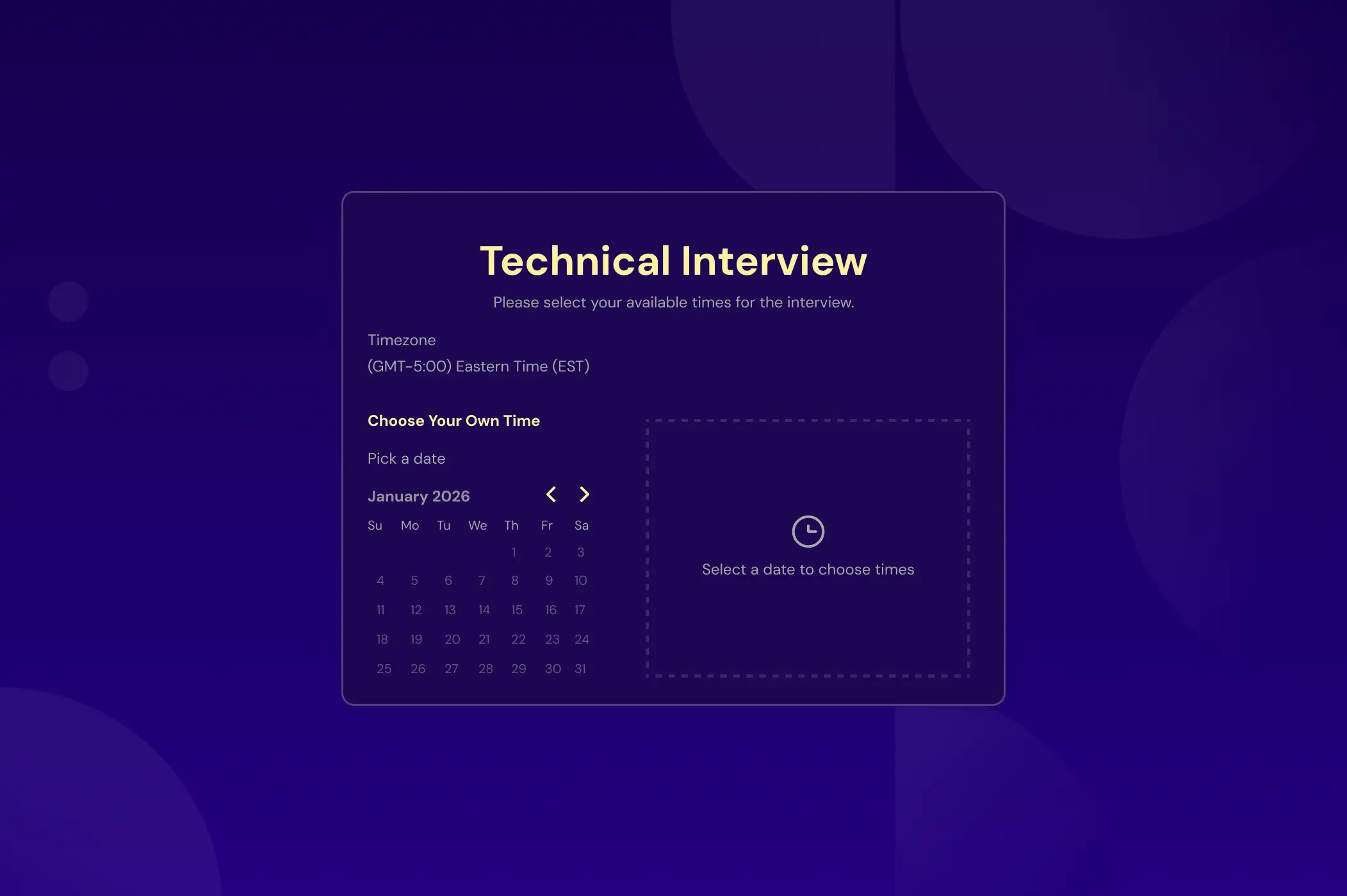
Candidate self-scheduling reduces time-to-interview from 5.9 to 3.9 days and scores 4.63/5 in satisfaction. Here's the data on why it outperforms availability requests.
AI Scheduling vs. Self‑Service Links: Which Delivers Better Candidate Experience?
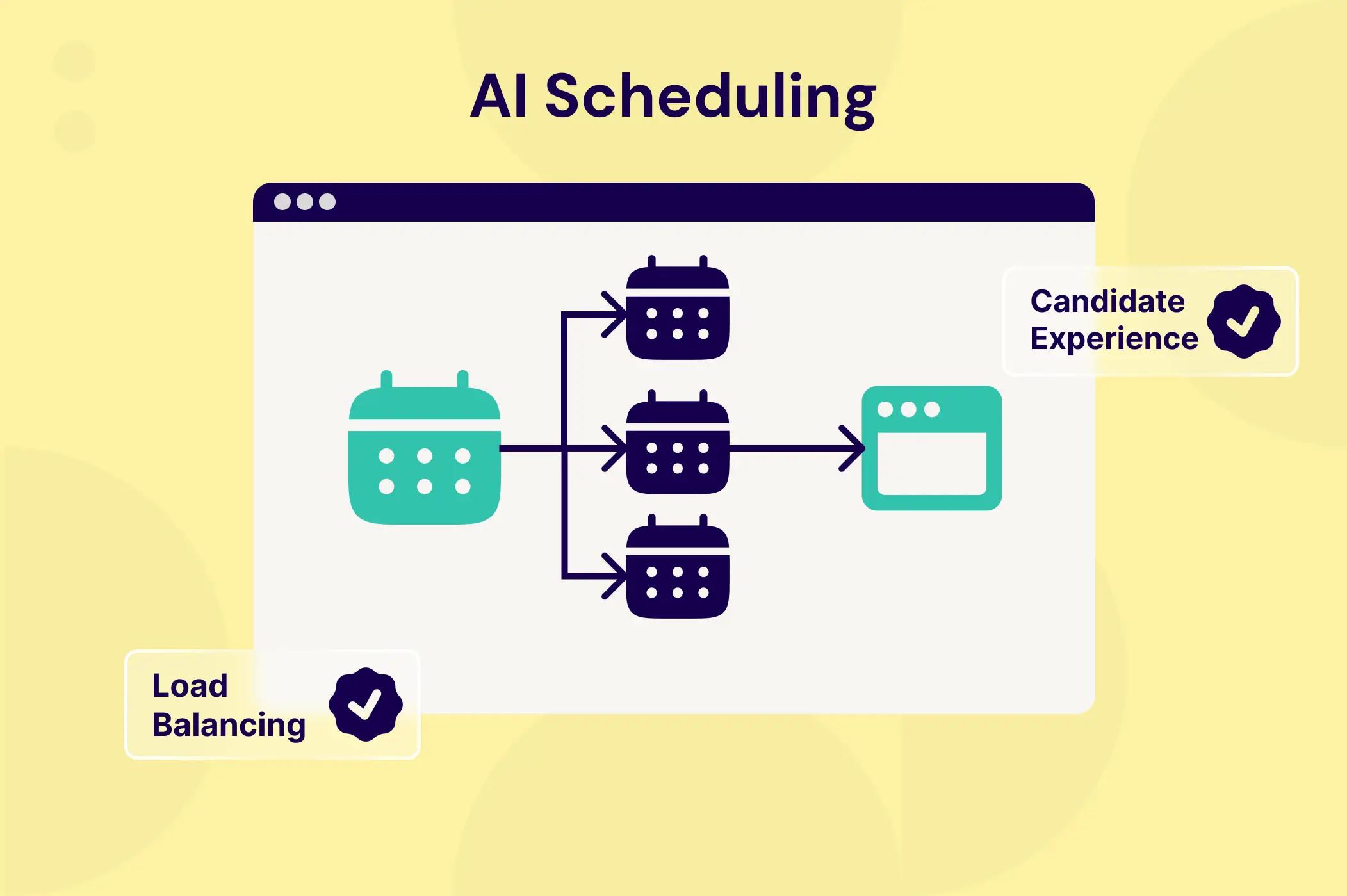
Booking links feel like a quick win because they eliminate the initial email tag. However, treating enterprise hiring like a simple calendar transaction creates hidden costs around interviewer burnout and disjointed candidate experiences.