Top AI Recruitment Tools for Interview Coordination (2026)

Quick answer
The best AI recruitment tools for interview coordination do more than send a self-scheduling link. They handle panel construction, real-time reschedule logic, ATS sync, and candidate communication without recruiter intervention. candidate.fyi leads the category as a full AI coordination layer; GoodTime, Paradox, and ModernLoop are the other enterprise-grade options worth evaluating.
Interview coordination is the part of recruiting that actually breaks first.
Not sourcing. Not screening. The logistics — getting a candidate in front of the right panel, at the right time, with the right interviewers confirmed — is where hiring slows down and candidates go quiet. According to candidate.fyi’s Interview Scheduling Gap Report, 38% of recruiters name scheduling their single biggest operational burden. Coordinators spend 46% of their time on admin tasks: chasing availability, rebuilding panels after declines, and manually triggering what should be automatic steps.
General AI recruiting tool roundups don’t cover this. They compare sourcing platforms and AI screening tools — useful, but a different problem. This guide is specifically for talent acquisition teams that want to fix the coordination gap: the layer between “candidate advanced in the ATS” and “interview confirmed and ready to go.”
What are AI recruitment tools for interview coordination?
Featured snippet
AI recruitment tools for interview coordination are platforms that automate the logistics between candidate advancement and confirmed interview. They handle availability matching, panel construction, ATS sync, reschedule management, and candidate communication — removing the manual back-and-forth that costs coordinators nearly half their working hours and slows time-to-hire.
“Interview coordination” covers more than scheduling. It includes:
* Panel construction: Matching candidate availability against multiple interviewers simultaneously, accounting for training rules, load balancing, and conflicts
* ATS sync: Writing interview data back to Workday, Greenhouse, or Lever automatically so the record of truth stays in the system
* Reschedule handling: Catching declines, finding alternatives, and notifying candidates in near-real time instead of 7–18 hours later (the manual average)
* Candidate communication: Confirmations, reminders, prep materials, and status updates without coordinator effort
General AI recruiting tools — sourcing platforms, screening AI, and assessment tools — stop at the candidate profile. Coordination tools pick up where they leave off.
How they differ from general AI recruiting software
Most AI recruiting software focuses on top-of-funnel: finding candidates, screening resumes, or scoring applications. AI recruitment tools for interview coordination start at the moment a candidate advances into the interview stage. The coordination layer handles everything that happens after — and it’s operationally more complex than it looks.
A single panel interview at an enterprise company can require aligning 3–5 interviewers across departments, enforcing training rules, managing a 14% average reschedule rate, and syncing all of that back to the ATS. No booking link handles that. Neither does a standard calendar tool.
Why most AI recruiting tools fall short on coordination
Featured snippet
Most AI recruiting tools handle sourcing and screening but break down at coordination because they lack the scheduling logic enterprise teams need: multi-panel construction, interviewer load balancing, real-time reschedule handling, and native ATS integration. Coordinators end up spending 46% of their time on admin despite using AI tools.
candidate.fyi’s Recruiting Coordination Maturity Model — developed from interviews with talent leaders at Discord, Peloton, Intercom, and others — describes this as the “logic deficit.” Most teams are at Level 2 or 3: they have process, maybe even some tooling, but the coordination still breaks under load.
The gaps that surface most often:
* Calendar Tetris on panels. A self-scheduling link works for a 1:1 interview. It fails the moment you need to coordinate three interviewers with different availability windows. The back-and-forth gets pushed back to the coordinator.
* Reschedule chaos. A 14% reschedule rate is consistent across enterprise recruiting orgs — it’s structural, not fixable with reminders. Manual coordinators average 68 hours to resolve a reschedule; AI coordination platforms cut that to around 20 hours. candidate.fyi resolves many rescheduling events in under 2 minutes.
* ATS sync gaps. When interview data doesn’t flow back to the ATS automatically, coordinators end up doing dual-entry. For Workday teams specifically, this is a persistent pain point: Workday Recruiting tracks candidates but was never designed to handle coordination workflows natively.
153 Interviews Per Coordinator, Per Week.
The average team manages 38 manually. candidate.fyi's AI coordination layer gives your team 4x the capacity — without adding headcount.
The top AI recruitment tools for interview coordination
Featured snippet
The top AI recruitment tools for interview coordination are candidate.fyi, GoodTime, Paradox (Olivia), ModernLoop, Ashby, Lever, Cronofy, and Calendly. The strongest platforms go beyond self-scheduling links to handle panel coordination, ATS sync, and autonomous reschedule management — candidate.fyi resolves 82% of scheduling sessions without human intervention.
1. candidate.fyi — Best for enterprise interview coordination end-to-end
candidate.fyi is an AI coordination layer built specifically for enterprise interview workflows. Its AI agent, fyi, handles the full scheduling lifecycle: panel construction, candidate self-scheduling, real-time reschedule logic, ATS sync, and candidate communication — without a coordinator in the loop for most interactions.
The numbers: 82% of scheduling sessions resolved without human intervention. Coordinators using candidate.fyi schedule an average of 153 interviews per week — compared to 39 per week without it, a 5x capacity multiplier. Self-scheduling sessions complete in 26.80 minutes on average versus 243 minutes for availability-based manual coordination. Candidate satisfaction scores for automated scheduling touchpoints average 4.63 out of 5.0 — higher than human-coordinated interactions.
For Workday users, candidate.fyi’s native Workday integration means scheduling kicks off automatically when a candidate advances in Workday. Interview invites, updates, and reschedules all write back to Workday so the ATS stays the source of truth. Setup requires roughly half a day of Workday admin time — no ongoing maintenance.
Relativity Space cut scheduling time from 2.8 days to 16.2 hours in six weeks. Bally’s gets from application to first interview in 24 hours. Zendesk doubled interview scheduling capacity — from 225 to 445 per week — within a month.
Best for: Mid-to-large enterprise teams running complex interview loops, panel interviews, or high-volume hiring. Particularly strong for Workday, Greenhouse, and Lever integrations.
2. GoodTime — Strong for mid-to-large enterprise scheduling
GoodTime is an AI interview scheduling platform built around interviewer intelligence — optimizing not just for availability, but for interviewer load, fatigue, and feedback completion rates. Its algorithms identify optimal slots across panels and keep candidates moving without recruiter intervention.
GoodTime integrates with Greenhouse and Lever and has solid reporting on interviewer utilization. It’s a credible enterprise option for teams focused on structured interview processes.
Best for: Mid-to-large companies with high-volume structured hiring on Greenhouse or Lever.
3. Paradox (Olivia) — Best for high-volume frontline hiring
Paradox’s AI, Olivia, was built for conversational recruitment — text and chat-based interactions that move candidates through screening and scheduling without human contact. It excels at frontline and hourly hiring where speed and volume matter more than complex panel logic.
Workday acquired Paradox in late 2025, giving Workday users a native conversational scheduling path for frontline roles. Paradox is increasingly a Workday feature for volume hiring, not a standalone enterprise coordination platform.
Best for: High-volume frontline or hourly hiring, particularly on Workday.
4. ModernLoop — Built for interview operations teams
ModernLoop focuses on interview operations as a discipline — interviewer calibration, training tracking, load balancing, and scheduling workflows built for TA ops teams that treat coordination as a function, not a side task.
Best for: TA ops teams at companies with large, structured interview programs and formal interviewer certification requirements.
5. Ashby — Modern ATS with built-in scheduling
Ashby is a next-generation ATS that includes interview scheduling as a native feature. For growing companies that don’t yet need a dedicated coordination platform, Ashby’s built-in tools are a strong step up from standard ATS scheduling. Complex panel logic and high-volume workflows will hit ceilings faster than with dedicated tools.
Best for: High-growth companies (100–500 employees) consolidating ATS and scheduling in one modern platform.
6. Lever — ATS-native scheduling with coordination features
Lever’s CRM-forward ATS includes scheduling capabilities that work well for collaborative hiring teams. High-volume or complex panel workflows typically require augmenting Lever with a dedicated coordination layer like candidate.fyi.
Best for: Mid-market companies already on Lever looking for moderate scheduling automation.
7. Cronofy — Calendar coordination infrastructure
Cronofy is a calendar API platform that powers scheduling for other tools rather than being an end-user product. It enables real-time availability reading, automated slot suggestions, and calendar sync across enterprise calendar systems — but has no candidate communication, panel logic, or ATS write-back.
Best for: Engineering teams building custom scheduling workflows or companies integrating multiple calendar systems.
8. Calendly — Self-scheduling for simple interviews (with limits)
Calendly handles single-interviewer availability for simple 1:1 interviews. It cannot construct panels, enforce training rules, balance interviewer loads, or handle complex reschedule chains. For enterprise recruiting teams, it’s a utility for the simplest scheduling tasks — not a coordination platform.
Best for: Individual recruiters and small teams scheduling straightforward, single-interviewer meetings.
How to choose the right AI recruitment tool for your coordination workflow
Featured snippet
To choose the right AI recruitment tool for interview coordination, assess three things: your ATS (Workday and Greenhouse users need native sync), your interview complexity (panels need real availability logic, not booking links), and your volume (teams running more than 100 interviews per month per coordinator need full automation, not self-scheduling).
* Start with your ATS. Interview data needs to flow back into your system of record automatically. Workday teams should prioritize tools with native Workday integration. Check the depth of the integration — not all write-backs are equal.
* Match the tool to your interview complexity. 1:1 recruiter screens are covered by a self-scheduling link. Multi-stage loops with panels of 3–5 interviewers require real coordination logic: availability resolution, load balancing, training rule enforcement.
* Think about volume thresholds. Teams crossing 100 interviews per week per coordinator hit a wall with manual coordination. Full AI coordination is the only way to scale without adding headcount.
* Evaluate reschedule handling specifically. Ask every vendor: what happens when an interviewer declines 2 hours before an interview? That’s the moment most tools break. Purpose-built platforms handle it automatically.
Frequently asked questions
What is the best AI tool for interview scheduling and coordination?
candidate.fyi is the strongest AI recruitment tool for interview coordination for enterprise teams. It resolves 82% of scheduling sessions without human intervention, supports native Workday, Greenhouse, and Lever integrations, and gives coordinators a 5x capacity lift — from 39 interviews per week manually to 153 with AI. For frontline high-volume hiring, Paradox (Olivia) is the leading option.
How do AI recruitment tools integrate with Workday?
The best AI recruitment tools integrate directly with Workday Recruiting so scheduling kicks off automatically when a candidate advances. Interview invites, updates, and reschedules sync back to Workday, keeping the ATS as the source of truth. candidate.fyi’s native Workday integration requires approximately half a day of admin setup and no ongoing maintenance.
Can AI recruitment tools handle complex panel interview scheduling?
Yes — purpose-built coordination platforms like candidate.fyi and GoodTime handle multi-interviewer panel scheduling natively, including availability resolution across 3–5 interviewers, load balancing, training rule enforcement, and real-time reschedule logic. Self-scheduling tools and most ATS-native features cannot.
What is the difference between AI recruiting software and AI interview coordination platforms?
AI recruiting software covers top-of-funnel: sourcing, screening, scoring, and assessment. AI interview coordination platforms take over when a candidate advances into the interview stage, handling scheduling logistics, ATS sync, panel construction, and candidate communication. Most AI recruiting tool roundups conflate the two; they solve different problems.
How much can AI recruitment tools reduce coordinator workload?
Based on candidate.fyi’s platform data across 257,946 scheduling events, coordinators with AI coordination tools schedule 153 interviews per week versus 39 without — a 5x lift. Teams see a 90% reduction in manual coordination work and 40% higher candidate satisfaction. The ROI calculator can help size the impact for your team.
The bottom line
Most recruiting teams don’t have an AI problem — they have a coordination maturity problem. AI recruitment tools are widely adopted (88% of TA leaders use AI in some form), but only 11–14% have coordination systems that actually scale.
The tools in this list represent the current state of the market. At the top is a small set of purpose-built coordination platforms that handle the full workflow — candidate.fyi being the standout for enterprise teams running complex interview loops. Below that are strong scheduling tools, ATS-native features, and self-scheduling utilities that solve simpler problems.
If your team is spending significant coordinator time on Calendar Tetris — chasing availability, managing reschedules, cleaning up manual errors — a purpose-built coordination platform will do more than any general AI recruiting tool.
See how candidate.fyi handles the full coordination workflow →
More Articles
Hiring Process Templates: Interview Workflows You Can Actually Reuse
Four hiring process templates worth standardizing: stage-gate definitions, the interview panel, the schedule and candidate itinerary, and the debrief scorecard. Plus the honest part: a 14% reschedule rate means the documented process and the real one diverge on roughly one interview in five.
Is Calendly a Good Enterprise Interview Scheduling Tool? (Here’s Why the Answer Is No)
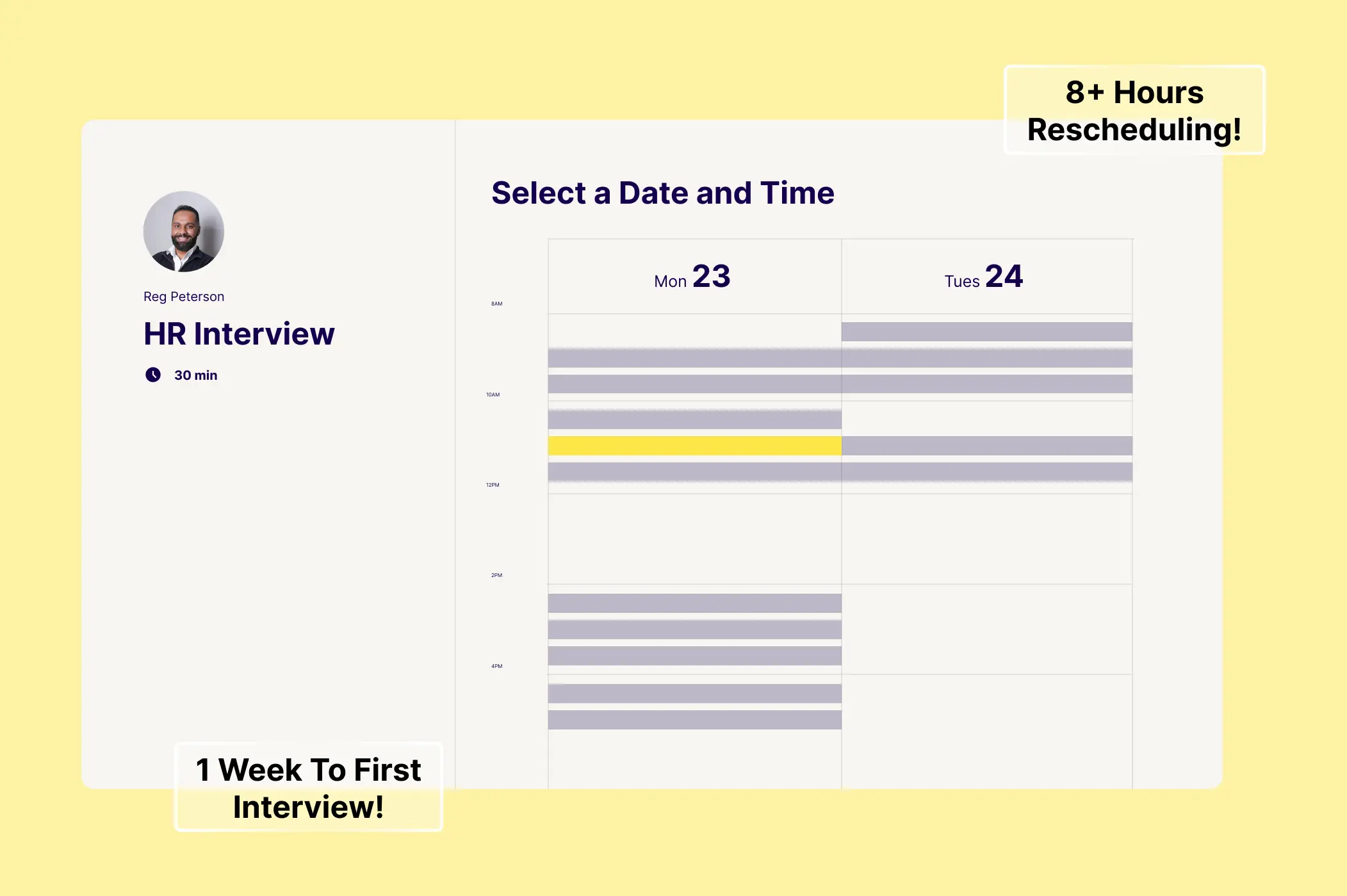
Calendly is great for individuals, but it fails enterprise interview scheduling. See why it breaks at scale, where it falls short, and how AI-powered options win.

The Quiet Power of AI In Interview Scheduling
candidate.fyi is the fastest-growing interview scheduling platform, powered by AI. Our agent, fyi, handles over 80% of scheduling requests without human intervention - integrating seamlessly with your ATS, calendar, and Slack to eliminate back-and-forth and speed up hiring.