How to Schedule an Interview: A Recruiter's Guide (2026)

Quick answer
Scheduling an interview takes six steps: confirm the panel and format, collect interviewer availability, give the candidate real options, send a confirmation carrying the details they need, brief the interviewers, and absorb reschedules. Steps two and three consume most of the time, and they are the two that automate cleanly.
A hiring manager writes "let's move them forward" in Slack. Everyone treats that as the end of a decision. It is actually the start of a process that will take four people, eleven messages and somewhere between two hours and nine days to complete.
That gap is the subject of this guide. Scheduling an interview is not one task. It is a short chain of dependent steps, and the chain has a specific failure point that shows up in nearly every recruiting team: the moment you need three or four busy calendars to agree on one hour.
What follows is the full process, written for the person actually doing it. It covers the steps in order, what changes when the interview is a panel rather than a single conversation, and how to tell when your process has outgrown manual coordination.
What scheduling an interview actually involves
Featured snippet
Scheduling an interview means matching four moving parts: candidate availability, interviewer availability, the interview format, and the tooling that holds it together. A single 45 minute conversation involves two calendars. A four person panel involves five, and every added calendar multiplies the possible combinations rather than adding to them.
Most guides on this topic describe scheduling as sending an invitation. That is the last five percent of the work. The part that consumes a coordinator's week is everything upstream of the invitation.
Consider the arithmetic. A single interview with one interviewer requires you to find an overlap between two calendars. A four person panel requires an overlap across five, and if the panel runs as a sequence rather than a single block, you are not looking for one shared hour but for four consecutive hours that each work for a different person. The number of valid arrangements collapses fast.
This is why scheduling load does not scale with headcount in the way people expect. Doubling your interview volume does not double the coordination work. It does something worse, because the harder requests take disproportionately longer to solve.
How to schedule an interview, step by step
Featured snippet
The six steps are: confirm the panel and format before touching a calendar, collect interviewer availability, present the candidate with real bookable options, send a confirmation containing the interviewer names and format, brief the interviewers with the resume and their focus area, then manage reschedules against a defined rule rather than case by case.
Step 1. Confirm the panel and the format before you touch a calendar. The single most common cause of a rescheduled interview is starting to schedule before anyone agreed who is on the panel. Pin down the interviewers, the order, the duration of each session, the format (video, phone or onsite) and who owns the hiring decision. If your intake meeting was done properly, most of this is already written down.
Step 2. Collect interviewer availability. This is where the time goes. Reading calendars directly is faster than asking, because asking generates a thread. If you have to ask, ask for windows rather than specific slots, and give a deadline. Watch for the interviewers whose calendars are technically open but who are functionally unavailable, which is a real pattern our data on interviewer declines by weekday makes visible.
Step 3. Give the candidate real options. Send three or more genuine choices, or better, let the candidate self-schedule against live availability. Sending a single proposed time is the slowest possible approach, because a decline restarts the entire loop. Candidate self-scheduling cuts time to interview by roughly two days for exactly this reason.
Step 4. Send a confirmation that answers the candidate's questions before they ask. The calendar invitation is not a confirmation. See the section below for what belongs in it.
Step 5. Brief the interviewers. Attach the resume, state the focus area for that specific session, and name what the previous interviewer already covered. An interviewer who arrives without context asks the same three questions the last one asked, which candidates read as a disorganised team.
Step 6. Handle reschedules against a rule. Reschedules are not exceptions. Decide in advance who has authority to move an interview, how far in advance a change is acceptable, and whether the panel gets rebuilt or the session gets dropped. Teams without a rule renegotiate every single time.
Loop scheduling: what changes with a panel
Featured snippet
Loop scheduling means arranging several back to back interviews as one dependent chain. Unlike a single interview, every session depends on the one before it, so one interviewer dropping out invalidates the whole arrangement rather than one slot. Loops need a rebuild rule and deliberate slack between sessions.
A loop, sometimes called a panel or an onsite, is not a single interview repeated. It is a chain, and chains fail differently. If the second of four sessions falls through, you do not lose one session. You lose the shape of the day, because the third and fourth interviewers are now holding time that no longer sits next to anything.
Three things make loops survivable.
* Build in slack. Ten minutes between sessions absorbs the interview that runs long without cascading into everyone's afternoon.
* Define substitutes in advance. For each panel seat, name who can cover it. A named backup turns a crisis into a swap.
* Decide what a rebuild costs. Some loops should be rebuilt when one seat breaks. Others should proceed with three interviewers and a written note. Knowing which is which in advance saves the twenty minute conversation that happens at 8am on the day.
At genuine volume this becomes its own discipline. Our breakdown of what it takes to run 40 interviews in one day covers the version of this problem at superday scale.
What belongs in the interview confirmation
Featured snippet
An interview confirmation should carry the date and time in the candidate's timezone, the duration, the format and joining link or address, every interviewer's name and job title, what to prepare, a reschedule link, and a named contact if something goes wrong on the day. Most confirmations include the first three only.
The confirmation is the cheapest quality improvement available in the entire process, and it is almost always underbuilt. A calendar invitation with a video link answers one question. Candidates have six.
* The date and time, stated in the candidate's own timezone, not yours.
* How long it will run, per session if it is a loop.
* The format and the joining details, or the physical address plus where to go on arrival.
* Who they are meeting, by name and job title, so they can prepare properly.
* What to bring or prepare, including any exercise or portfolio review.
* A reschedule link, and the name of a human to contact if something breaks that morning.
The last item is the one teams resist, on the theory that offering a reschedule link invites reschedules. The opposite happens in practice. Candidates who cannot find a way to move an interview do not attend anyway, they simply stop responding, which converts a solvable scheduling conflict into a no-show you paid interviewer time for.
153 Interviews Per Coordinator, Per Week.
The average team manages 38 manually. candidate.fyi's AI coordination layer gives your team 4x the capacity — without adding headcount.
Manual, self-service links, or automated scheduling
Featured snippet
Manual scheduling works below roughly ten interviews a week. Consumer booking links work for single interviewer conversations but break on panels, because they cannot solve for several calendars at once. Automated interview scheduling earns its cost when panels, timezones or reschedule volume make the combinations too many to solve by hand.
There are three honest ways to schedule interviews, and the right answer depends entirely on your volume and your panel complexity.
Manual coordination is genuinely fine at low volume. If you run fewer than ten interviews a week and most are single interviewer conversations, a coordinator reading calendars and sending options is efficient. Introducing software here solves a problem you do not have.
Consumer booking links such as Calendly work well for one to one meetings and fail specifically on panels, because they were built to expose one person's availability rather than reconcile five. They also sit outside your ATS, which means the interview exists in a place your hiring workflow cannot see. We covered the enterprise version of this problem in detail in our piece on whether Calendly works for enterprise interview scheduling.
Automated interview scheduling reads live availability across the whole panel, applies your rules about interviewer load and training requirements, and lets the candidate book directly into a valid arrangement. The gain is not that it sends invitations faster. It is that it evaluates thousands of possible arrangements in the time a person evaluates three. Zendesk went from 225 to 445 interviews per week in their first month on candidate.fyi, and the headcount doing the coordinating did not change.
The switching point is easier to identify than most teams think. If your coordinators regularly spend more than a quarter of their week inside calendars, or if panel interviews routinely take more than a day to confirm, the combinations have outgrown manual solving. Our complete guide to automated interview scheduling works through the evaluation in depth, and interview scheduling best practices covers the process changes that should accompany it.
Where scheduling sits in the hiring process
Featured snippet
The hiring process runs from requisition approval through sourcing, screening, interviewing, offer and close. Scheduling is not a stage of its own, which is why it goes unmeasured. It sits inside the interview stage, and the interval between a decision to advance and a confirmed slot is where most measurable delay accumulates.
Standard hiring process steps look roughly like this: open and approve the requisition, source and attract candidates, screen applicants, interview, decide, extend the offer, then close and onboard.
Notice that scheduling does not appear. It is not a stage, it is connective tissue between stages, which is precisely why almost nobody instruments it. Time to hire starts counting at requisition open and stops at offer accepted. Everything scheduling costs you is inside those brackets, invisible.
The number worth adding to your dashboard is narrow and specific: the median time from a hiring manager deciding to advance a candidate to that candidate holding a confirmed slot. Not time to hire, not time to interview from application. Just that interval. Most teams have never measured it, and it is usually the largest controllable delay in the funnel. Our 2026 recruiting funnel benchmarks put the surrounding conversion rates in context.
Frequently asked questions
How long should it take to schedule an interview?
For a single interviewer conversation, the same working day is achievable and should be the standard. For a panel of three or more, a well run manual process typically lands within two to three business days, and an automated one within hours. If your panels routinely take a week, the bottleneck is availability discovery, not candidate responsiveness.
What is the best way to ask a candidate for their availability?
Do not ask in open form. "What times work for you next week" produces a list that will not match your interviewers and starts a negotiation. Present three or more specific options that are already valid against the panel, or send a self-scheduling link showing live availability. The candidate should be choosing, not proposing.
What is loop scheduling?
Loop scheduling is the arrangement of several back to back interview sessions as a single dependent sequence, usually for an onsite or final round. The defining feature is that the sessions depend on each other, so a change to one session invalidates the arrangement rather than just that slot.
Should candidates be allowed to self-schedule?
Yes, provided the options they see are already valid against your panel and your interviewer rules. Self-scheduling against live, filtered availability removes an entire round of back and forth. Self-scheduling against an unfiltered calendar just relocates the problem, because the candidate books something your interviewers cannot actually attend.
How do you schedule interviews across time zones?
State every time in the candidate's local timezone and label it explicitly. Never send a time without a timezone, and never make the candidate do the conversion. Where a panel spans regions, define an acceptable working window per interviewer rather than allowing bookings anywhere their calendar is technically free.
What should you do when an interviewer cancels?
Apply the rule you set in advance. Either substitute the named backup for that panel seat, proceed with the remaining interviewers and record which competency went uncovered, or rebuild the loop. Decide which of the three applies before the cancellation happens, because deciding in the moment is what turns one cancellation into a rescheduled day.
The bottom line
Scheduling an interview is a six step process whose difficulty is concentrated almost entirely in one step: finding an arrangement that several busy calendars will accept. Everything else is administration that can be written down and followed.
So the useful question is not how to schedule interviews better. It is whether the number of arrangements your team needs to evaluate each week has passed the point where a person can evaluate them. Below that line, a good process and a careful coordinator beat any tool. Above it, no amount of care closes the gap, because the constraint is combinatorial rather than behavioural.
Measure the interval between the decision to advance and the confirmed slot. That single number will tell you which side of the line you are on.
If you want to see what the automated version looks like against your own panel structure, book a walkthrough with candidate.fyi and bring your hardest loop.
More Articles
9 AI Interview Scheduling Tools for Fast Hiring (2026)
Compare the 9 best AI interview scheduling tools for enterprise recruiting teams. See how candidate.fyi, GoodTime, Paradox, ModernLoop, and more stack up on automation depth, ATS integration, time zone handling, and coordinator capacity — with real platform data.
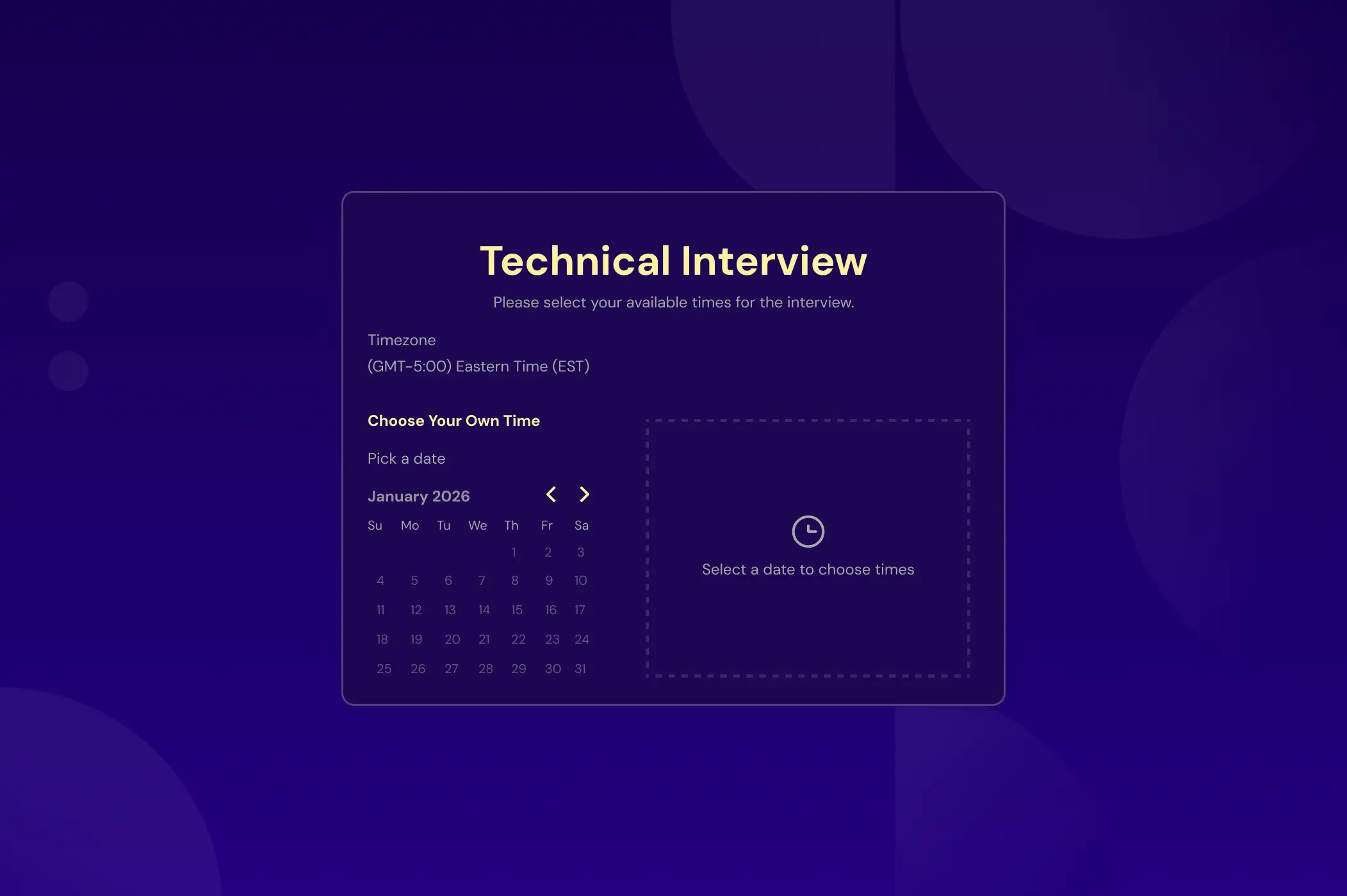
Candidate Self-Scheduling Reduces Time-to-Interview by Two Days
Candidate self-scheduling reduces time-to-interview from 5.9 to 3.9 days and scores 4.63/5 in satisfaction. Here's the data on why it outperforms availability requests.
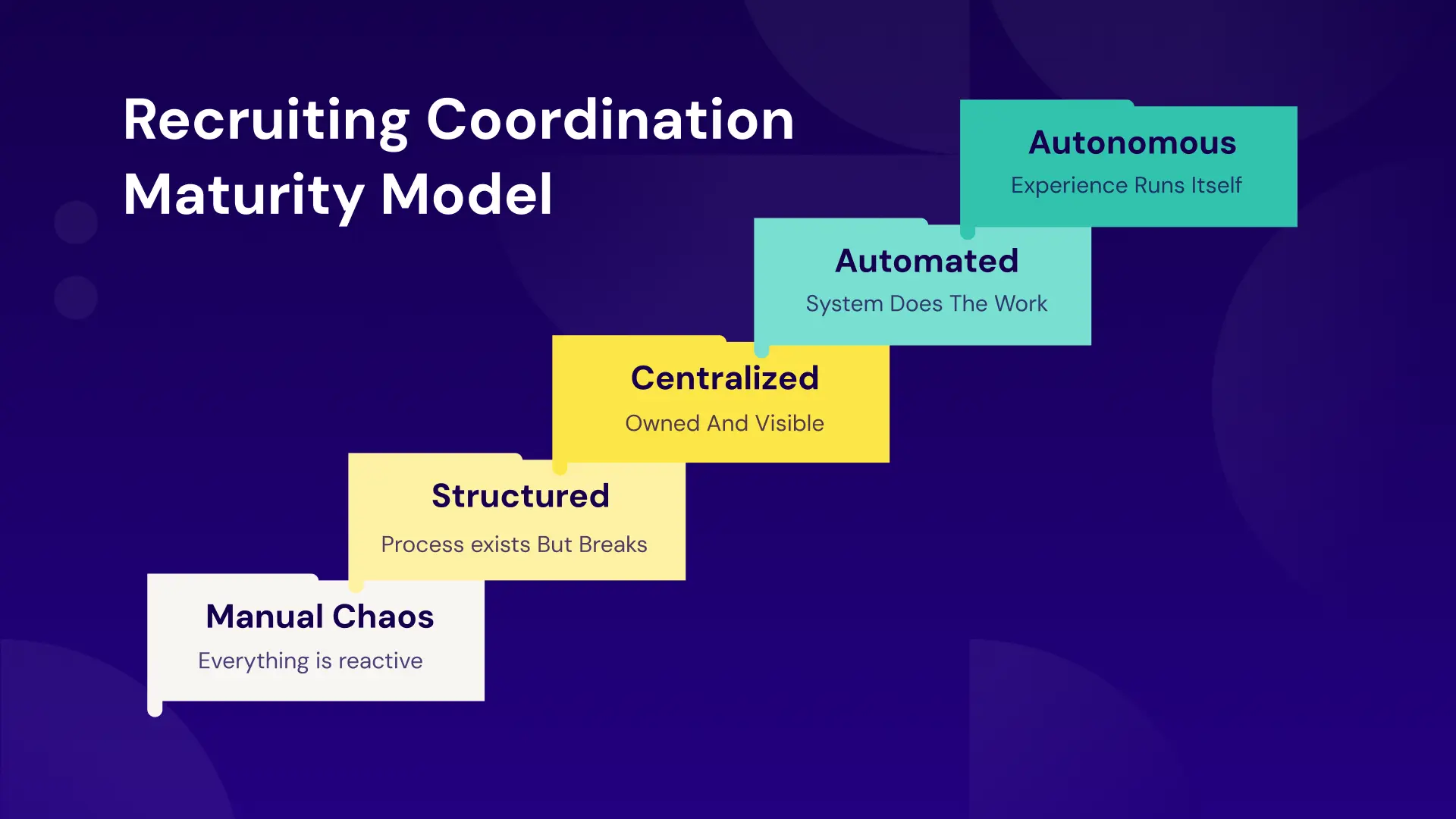
Interview Schedule Optimization: The 5-Level Maturity Model That Determines Hiring Speed
Recruiting teams are struggling with slow interview scheduling, and the problem is maturity of their coordination mindset. This framework introduces five distinct levels of interview schedule optimization, from manual chaos to autonomous coordination.