Candidate Self-Scheduling Reduces Time-to-Interview by Two Days

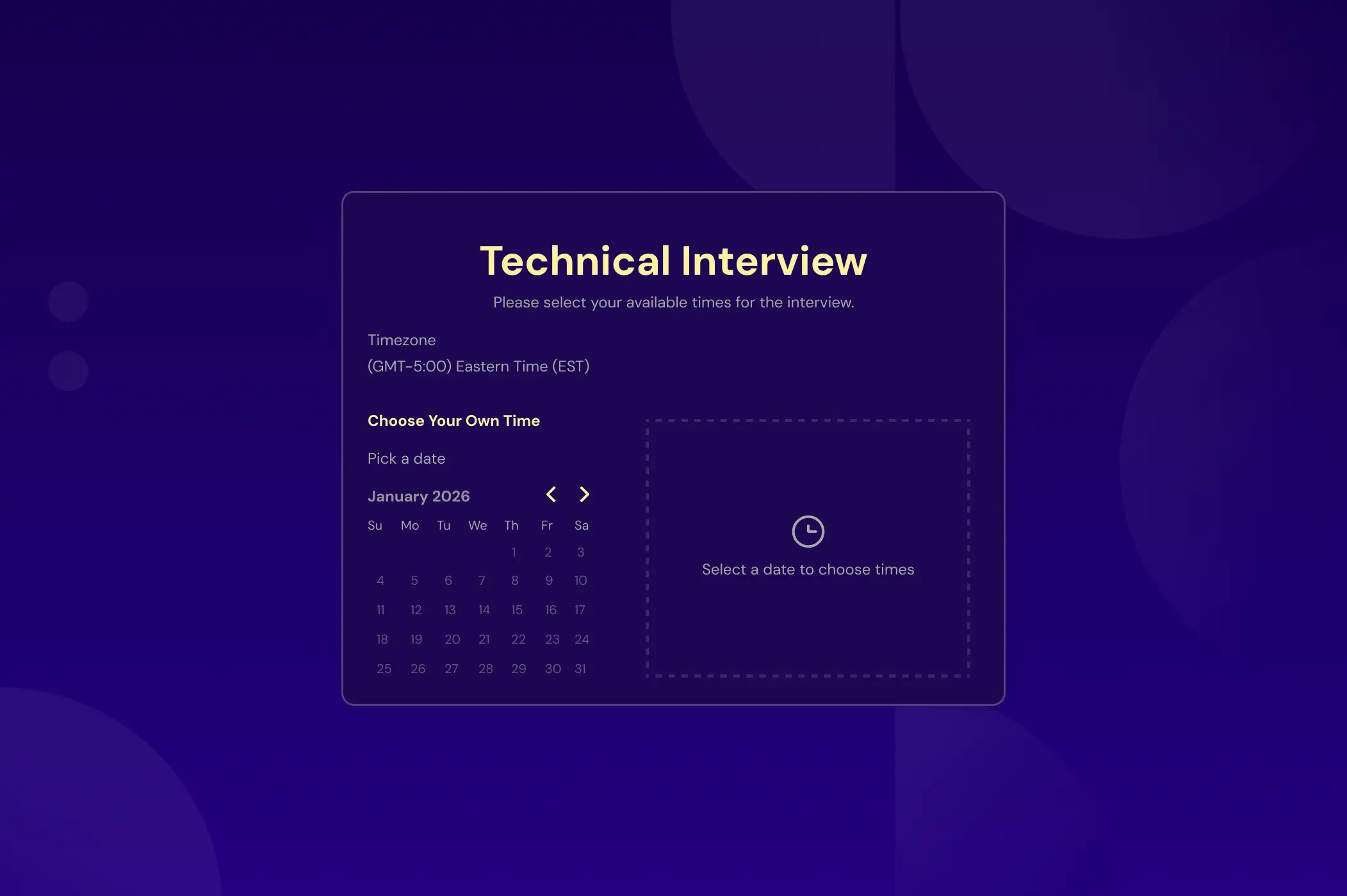
Availability requests have been the default interview scheduling method for years. A recruiter identifies a candidate to advance, sends an email asking for three to five available windows, waits for a response, cross-references that against interviewer calendars, proposes a time, and waits again. When everything goes smoothly, the interview gets booked in two to three days. When someone responds slowly or a preferred slot is already taken, the cycle restarts.
Candidate self-scheduling removes most of those steps. Candidates receive a link, see real available slots based on live interviewer calendars, and book directly. The confirmation goes to everyone automatically. The question for TA leaders is not whether self-scheduling is faster. The data makes that clear. The more useful question is why so many teams still default to availability requests, and what it costs them when they do.
Summary
Candidate self-scheduling reduces time-to-interview from 5.9 days to 3.9 days and cuts scheduling time from 243 minutes per interview to 27 minutes, a 9x improvement, according to internal candidate.fyi data across 12,000+ scheduling actions. Contrary to the assumption that automation makes hiring feel impersonal, self-scheduled recruiter screens score 4.63 out of 5 in candidate satisfaction, the highest of any interview type. The data from the Recruiting Coordination Wrapped Report, which analyzed 257,946 coordination signals, shows that availability requests create a multi-day dead zone between candidate interest and confirmed interview that costs teams top candidates. Enterprise teams using self-scheduling handle up to 158 interviews per coordinator per week, compared to roughly 30 for manual teams.
What Is Candidate Self-Scheduling?
Candidate self-scheduling is a workflow in which candidates book their own interview from a set of pre-approved time slots, generated in real time from interviewer calendar availability. The candidate receives a scheduling link, selects a time that works for them, and the interview is confirmed without a coordinator manually coordinating between parties.
This is different from an availability request, where the candidate submits preferred times and a coordinator reviews them before confirming. With self-scheduling, the confirmation is automatic once the candidate selects a slot.
At enterprise scale, self-scheduling platforms pull availability from every panelist's calendar simultaneously, apply interviewer pool logic and load-balancing rules, surface only slots where all required attendees are free, and sync the confirmed booking back to the ATS without manual data entry. Candidates are not choosing from a static list. They are choosing from a live, dynamic window that reflects actual interviewer availability at the moment they open the link.
Why Does Time-to-Interview Matter More Than Time-to-Schedule?
Time-to-schedule measures how long it takes to confirm an interview slot. Time-to-interview measures how long it takes from recruiter decision to the candidate actually sitting in the chair. The second number is what determines whether top candidates stay in your process.
Greenhouse's 2026 benchmark report analyzed data from over 6,000 organizations and found that the average time to fill a role has increased by 36.8% since 2022, reaching 56.7 days. Application volume per recruiter has grown by 411.8% over the same period, while recruiter team sizes have dropped by 55.6%. More interviews to coordinate, fewer people to coordinate them, and candidates who are actively evaluating multiple employers simultaneously.
In that environment, every day a candidate waits for a confirmed interview date is a day their interest can shift to a competitor who moved faster. The research is clear on this: Greenhouse data shows 24% of candidates who ghost employers cite slow communication or long delays as their reason for withdrawing. They wanted the job. The process itself pushed them away.
Self-scheduling compresses the gap between recruiter decision and confirmed interview. Manual scheduling stretches time-to-interview to 5.9 days on average. Self-scheduling cuts that to 3.9 days. That two-day difference, multiplied across hundreds of open roles at enterprise scale, has a measurable effect on offer acceptance rates and pipeline conversion.
What Does the Data Say About Self-Scheduling vs. Availability Requests?
The comparison is direct. Based on candidate.fyi data across 257,946 coordination signals:
Time-to-schedule drops from 243 minutes with availability requests to 27 minutes with self-scheduling. That is nine times faster, and it represents the difference between a half-day coordination task and something that resolves in under half an hour.
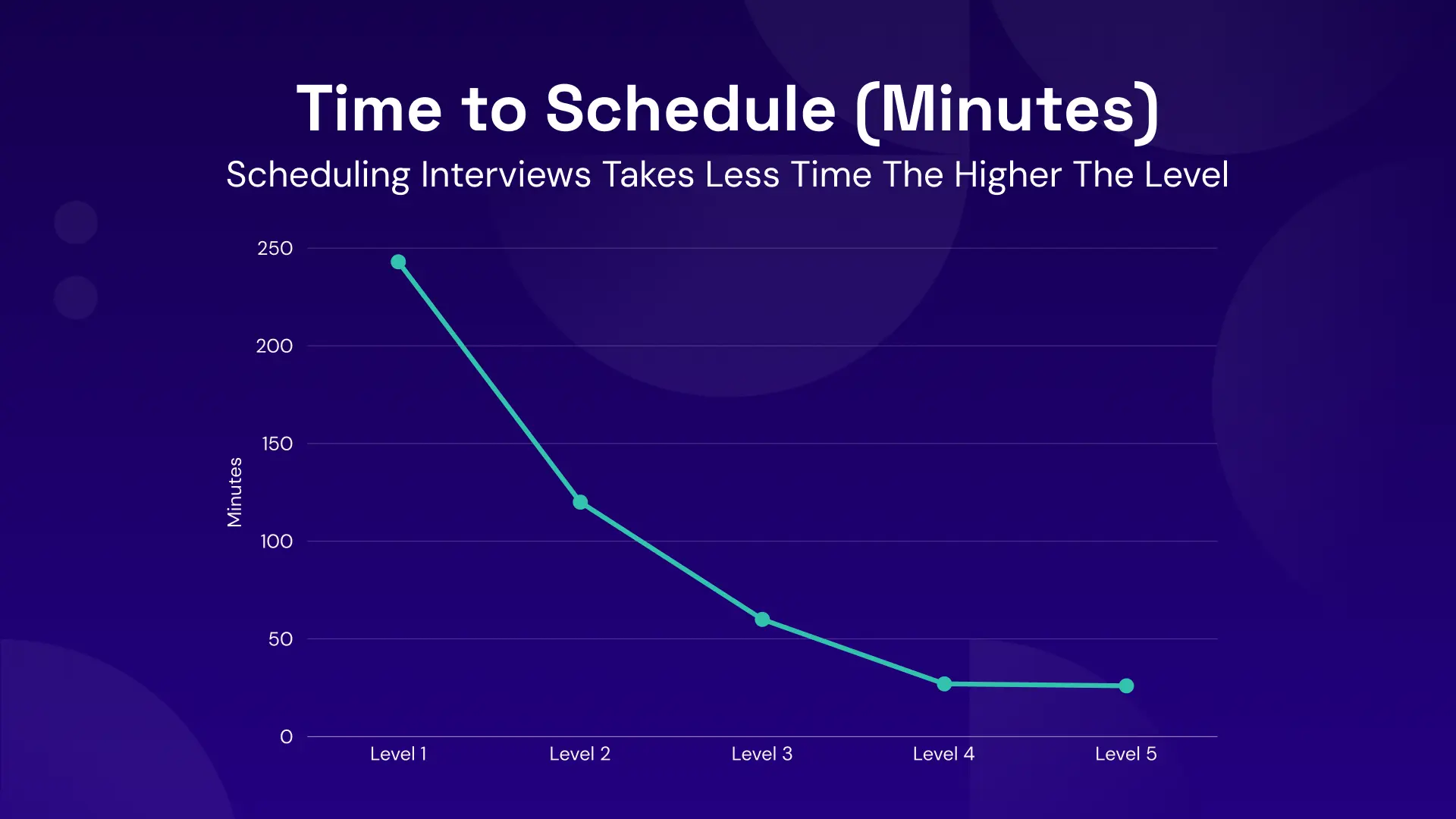
Time-to-interview drops from 5.9 days to 3.9 days. The two-day improvement comes from eliminating the waiting periods embedded in the availability request cycle: the candidate's response window, the coordinator's cross-reference and confirmation step, and the second response window if the first proposed time does not work.
Candidate satisfaction scores 4.63 out of 5 for recruiter screens, the most automated interview type in the scheduling process. Hiring manager interviews, which involve more manual coordination and are more likely to be rescheduled, score lower at 4.22. The data directly contradicts the assumption that automation makes the candidate experience feel cold. Candidates who can book their own interview on their schedule, receive immediate confirmation, and access their prep materials through a centralized portal report a better experience, not a worse one.
Coordinator capacity scales from roughly 30 interviews per week with manual scheduling to 158 interviews per week with AI-enabled self-scheduling, because 46% of coordination tasks are handled autonomously by the platform and an additional 26% are completed by candidates through self-service. The coordinator's time goes to the 28% that requires human judgment.
153 Interviews Per Coordinator, Per Week.
The average team manages 38 manually. candidate.fyi's AI coordination layer gives your team 4x the capacity — without adding headcount.
Why Do Recruiting Teams Still Send Availability Requests?
The objections to self-scheduling are real, but they apply specifically to tools that were not built for enterprise recruiting workflows. Understanding the distinction matters.
Panel interviews are genuinely hard to self-schedule with simple tools. Coordinators who have tried to run panel scheduling through Calendly or basic ATS booking features have encountered the same wall: these tools handle one-on-one bookings reliably and break on anything more complex. Greenhouse's own documentation acknowledges their self-schedule feature handles single-interviewer bookings only and cannot schedule two stakeholders on a call simultaneously. When a coordinator is managing a three-person panel across time zones, sending an availability request feels like the only option because the tools they have access to genuinely cannot do otherwise.
Calendar hygiene problems create legitimate distrust. A consistent complaint in recruiting forums is that automated tools surface slots the interviewer considers unavailable: "interviewer's schedules read as busy when they are actually available" is one of the most cited frustrations. The inverse is also common: a candidate books a slot that the interviewer had not blocked but considers protected time, creating friction before the interview even begins. When coordinators cannot trust that calendar data is accurate, they prefer to maintain a human review step.
Without ATS sync, self-scheduling creates new manual work. Recruiting coordinators who piloted Calendly for interview scheduling described the same failure pattern: "Calendly doesn't talk to Greenhouse. You still end up doing the same manual work just later in the process." A self-scheduling link that books an interview without writing back to the ATS means the coordinator has to update the candidate record manually, rebuild the interview confirmation in the ATS, and verify that all downstream notifications fired correctly. The tool saved one step and added three others.
The concern about confidential or senior roles. Coordinators managing executive searches or sensitive backfill situations sometimes prefer availability requests to maintain tighter control over what slot information is exposed and to whom. Sending a candidate a self-scheduling link for a confidential VP backfill role has felt risky when tools could not guarantee that the interview details were properly scoped.
Each of these objections describes a real limitation of general-purpose scheduling tools applied to enterprise recruiting. They do not describe enterprise scheduling platforms built specifically for this use case. A platform with live two-way calendar sync across all panelists, ATS write-back, and interviewer pool logic resolves the panel coordination problem directly. Candidates select from slots where every required attendee is genuinely available, not a static window that may already be stale. The ATS updates automatically. Load balancing and confidentiality controls are built into the workflow, not managed manually after the fact.
That is the gap between availability requests persisting out of habit and availability requests persisting because the right tooling was not in place.
What Does Candidate Self-Scheduling Require to Work?
Self-scheduling delivers its full benefit only when three infrastructure requirements are in place.
Live calendar integration across all interviewers. The scheduling link must pull from each panelist's calendar in real time, not from a manually maintained block schedule. This requires every relevant interviewer to have their calendar connected to the scheduling platform. When calendar data is stale or incomplete, the platform surfaces inaccurate availability and the coordinator loses confidence in the tool.
ATS sync that writes back automatically. The confirmed booking needs to update the candidate record, trigger the appropriate ATS stage movement, and fire confirmation emails to all parties without coordinator intervention. If any of those steps require manual cleanup, the efficiency gain is partially offset and adoption slows.
Interviewer pools with load-balancing rules. For panel interviews and multi-stage loops, the platform needs to know which interviewers are qualified for which roles, how many interviews per week each interviewer should carry, and what substitution logic applies when someone cancels. Without these rules in place, self-scheduling either surfaces unqualified panelists or requires a coordinator to review every booking before confirming, which recreates the delay the tool was meant to eliminate.
Teams that implement self-scheduling without these foundations in place see partial gains and conclude the approach does not work. The issue is almost always infrastructure readiness rather than the scheduling model itself.
How Does Self-Scheduling Impact Candidate Experience Scores?
The industry assumption heading into AI-powered scheduling was that automation would lower candidate satisfaction. Survey data from Greenhouse showed that 42% of candidates blame AI for a worse hiring experience. The scheduling data tells a different story.
Recruiter screens, the interview type with the highest degree of self-scheduling automation, produce the highest satisfaction scores in the dataset at 4.63 out of 5. The overall pulse score across all interview types is 4.41 out of 5, up from 4.32 the prior year. Hiring manager interviews, which carry more manual coordination, score 4.22. The correlation is consistent: higher automation in the scheduling process correlates with higher candidate satisfaction, not lower.
The explanation is straightforward. Candidates who self-schedule can book on their own time, including evenings and weekends, without waiting for a coordinator to process their availability request during business hours. They receive immediate confirmation rather than a pending window. They know exactly when their interview is, who they are meeting with, and what they need to prepare before a human coordinator has taken any action at all. That experience signals organization and respect for the candidate's time. Both matter to whether they accept an offer at the end.
How Do You Know If Your Team Is Ready to Implement Self-Scheduling?
Teams that see strong results from self-scheduling typically have three things in place before they go live. Teams that struggle usually skipped at least one.
First, interviewer calendars are connected and maintained. This sounds basic and is consistently the failure point. If hiring managers treat their calendars as approximate and block time manually only when they remember, self-scheduling will surface inaccurate availability from day one.
Second, the team has standardized its interview loops by role type. Self-scheduling platforms generate slots based on panel configurations. If the panel for a senior engineer role varies by recruiter preference rather than following a documented template, the platform cannot reliably construct the right panel for each booking.
Third, coordinators are trained to manage exceptions rather than every booking. The mindset shift required is from "I confirm every interview" to "the system confirms most interviews and I handle what escalates." Teams that try to run self-scheduling alongside a full manual review process do not see the capacity gains and often abandon the tool before the infrastructure investment pays off.
If all three are in place, self-scheduling typically shows results within the first few weeks. If any are missing, fixing the foundation before turning on self-scheduling will produce better outcomes than trying to learn the tool while also solving process problems.
Q&A
What is candidate self-scheduling?
Candidate self-scheduling is a workflow in which job candidates book their own interview from a set of available time slots generated in real time from interviewer calendars. The candidate selects a time, the platform confirms the booking automatically, and the ATS updates without coordinator intervention. In enterprise recruiting platforms, self-scheduling handles panel interviews across multiple attendees, respects interviewer load-balancing rules, and adjusts for time zones without manual coordination.
How much faster is self-scheduling than sending availability requests?
Self-scheduling reduces time-to-schedule from 243 minutes to 27 minutes, a 9x improvement, based on candidate.fyi data across 12,000+ scheduling actions. More meaningfully for hiring outcomes, it reduces time-to-interview from 5.9 days to 3.9 days. The two-day difference comes from eliminating the back-and-forth response cycles embedded in the availability request workflow.
Does candidate self-scheduling hurt candidate experience?
The data shows the opposite. Recruiter screens, the most automated interview type in the scheduling process, score 4.63 out of 5 in candidate satisfaction, the highest of any interview type analyzed. Hiring manager interviews, which involve more manual coordination, score lower at 4.22. Candidates who can book on their own time, receive immediate confirmation, and access prep materials through a centralized portal report a better experience than those who wait for a coordinator to process their availability.
What tools support candidate self-scheduling for enterprise teams?
General scheduling tools like Calendly support basic one-on-one self-scheduling but break on panel interviews, lack native ATS integration, and do not sync confirmed bookings back to applicant tracking systems automatically. Enterprise recruiting platforms built specifically for interview coordination, like candidate.fyi, handle multi-panelist scheduling with live calendar sync, ATS write-back, and load-balancing logic. The distinction matters because the operational objections to self-scheduling, including panel complexity and ATS cleanup, reflect limitations of general-purpose tools rather than the self-scheduling model itself.
More Articles
Recruitment Technology, and Where AI Actually Sits in the Stack
Every recruiting tool now claims AI, but the stack is still a set of separate layers, from the ATS through scheduling, interview intelligence and reporting. This guide shows which layer each AI claim belongs to, where the time in hiring actually goes, and where to start modernizing.
How Calendar Integrations Enable Automated Interview Scheduling
Calendar integrations are the mechanism behind automated interview scheduling — enabling real-time conflict detection, timezone resolution, and reschedule handling without coordinator involvement.
How to Build an Agentic AI Recruiting Strategy: A Step-by-Step Adoption Guide for TA Teams
Enterprise TA teams are moving from AI chatbots to autonomous agents. Here's a stage-by-stage roadmap for building an agentic AI recruiting strategy that scales.