What Is Recruiting Automation? A Practical Guide for Enterprise TA Teams


Recruiting automation has become one of the most discussed topics in talent acquisition, and one of the most misunderstood. For many TA leaders, the term still conjures vague ideas about chatbots and resume screening. In practice, the category spans a much wider range of workflows, from the moment a role opens to the moment a candidate gets an offer.
This guide is for enterprise TA leaders who want a clear-eyed view of what recruiting automation actually covers, where it delivers measurable ROI, and how to build a stack that complements your ATS without requiring a full systems overhaul.
Summary
Recruiting automation refers to using software and AI to replace repetitive, manual tasks in the hiring process. For enterprise talent acquisition teams in 2026, the most impactful categories are interview scheduling automation, candidate communication, job description creation, and feedback collection. The highest-ROI layer of the stack is interview coordination: AI-powered scheduling cuts interviewer decline response time from 68 hours to 21 hours, increases coordinator capacity by 5x, and produces candidate satisfaction scores of 4.63 out of 5, higher than processes with more manual touchpoints. The technology gap is widest precisely where the manual workload is highest.
What Is Recruiting Automation?
Recruiting automation is the use of software, workflows, and AI to complete repetitive hiring tasks with less manual effort. The goal is to reduce the time talent teams spend on coordination, communication, and administrative work so they can focus on the decisions that actually require human judgment: evaluating candidates, advising hiring managers, and building a strong pipeline.
Recruiting automation is not a single tool or a single category. It describes a broad set of capabilities that can be applied across the entire hiring lifecycle, from drafting a job description to scheduling a final-round interview to collecting post-hire feedback.
For enterprise teams managing high volumes of requisitions across multiple time zones, automation is no longer a competitive advantage. It is an operational requirement. Gartner reports that 78% of recruiting leaders face stagnant or shrinking budgets, while Workday data shows a 32% global increase in job applications against a backdrop of declining open roles. Teams are being asked to do more with fewer resources, and the hiring workflows most dependent on manual effort are the ones breaking first.
Which Recruiting Workflows Are Most Commonly Automated?
The six areas where enterprise TA teams are successfully applying automation today:
Interview scheduling. This is the highest-volume, most time-intensive coordination task in recruiting. Manual scheduling costs teams an average of 243 minutes per interview, according to internal candidate.fyi data across 12,000+ scheduling actions. Automated scheduling, through candidate self-scheduling portals and AI-powered panel construction, cuts that to 27 minutes. The gap is nine times, and it compounds fast at enterprise scale.
Candidate communication. Confirmation emails, interview reminders, prep materials, and next-step updates can all be automated through triggered workflows tied to scheduling milestones. Greenhouse research shows that 24% of candidates who ghost employers cite slow communication as their reason. Most of that communication delay is a workflow problem that automation solves.
Job description creation. Enterprise TA teams have started using AI agents trained on past JDs, job architecture documentation, and company voice guidelines to generate first drafts. What used to require days of back-and-forth across recruiters, HRBPs, and hiring managers now produces a usable draft in minutes. Human review still happens, but the approval cycle shortens significantly when the starting point is already 80% right.
Interviewer feedback consolidation. Recruiters spend real time each week pulling feedback from ATS screens, consolidating it, and formatting it for hiring manager prep meetings. AI tools can ingest scattered feedback entries and produce a structured summary, turning a 30-minute manual task into a 2-minute review.
Pulse feedback collection. Traditional candidate surveys go out after a final decision, when response rates drop below 20% and the feedback is too late to act on. Automated pulse surveys sent immediately after each interview stage capture real-time sentiment with significantly higher completion rates. The completion rate has reached over 48% for some of our customers. Teams gain visibility into candidate experience problems before they cause drop-off.
Candidate sourcing and ranking. AI-powered screening tools can rank applicants against a job description and defined criteria, helping recruiters prioritize outreach without reviewing every application manually. For high-volume roles, this is the difference between a meaningful shortlist and a pile of resumes.
How Does Recruiting Automation Work at Enterprise Scale?
The clearest illustration of what enterprise scale actually means for recruiting coordination is what happens every Monday morning. Across 257,946 coordination signals analyzed in the Recruiting Coordination Wrapped Report, Monday produces 40% more interviewer declines, candidate declines, and reschedules than any other day of the week. On manual teams, coordinators spend Monday triaging a backlog that built overnight. On automated teams, the AI agent processes the same volume while the coordinator starts the week on higher-priority work.
That Monday pattern reflects a broader reality: at enterprise scale, the exception is not the exception. The Wrapped Report found that 14% of all interviews are rescheduled. For a team running 500 interviews a week, that is 70 manual rebuilds every week, not counting declines, no-shows, or last-minute panel changes. Simple booking tools handle the straightforward case well. They stop working the moment human behavior introduces complexity, which at enterprise volume happens constantly.
Enterprise recruiting automation handles exceptions as part of the standard workflow. When an interviewer declines, the system identifies a trained replacement from a pre-defined pool and engages them via Slack or email. When a candidate needs a different time, the platform adjusts without coordinator intervention. The coordination logic runs in the background whether it is a routine confirmation or a panel rebuild at 7am on a Monday.
The other critical factor at enterprise scale is ATS integration. Recruiting automation only delivers its full value when scheduling updates, candidate status changes, and feedback submissions write back to your system of record automatically. Without that integration, coordinators are still doing manual data entry, just faster.
Diagnose Your Interview Scheduling Pains
Take the 2-minute Recruiting Coordination Maturity Assessment and discover exactly where your team stands and what to fix next.
Why Does Interview Scheduling Automation Deliver the Highest ROI?
Among all the recruiting workflows that can be automated, interview scheduling is where the math is most compelling, and the clearest proof point is not the one most people expect.
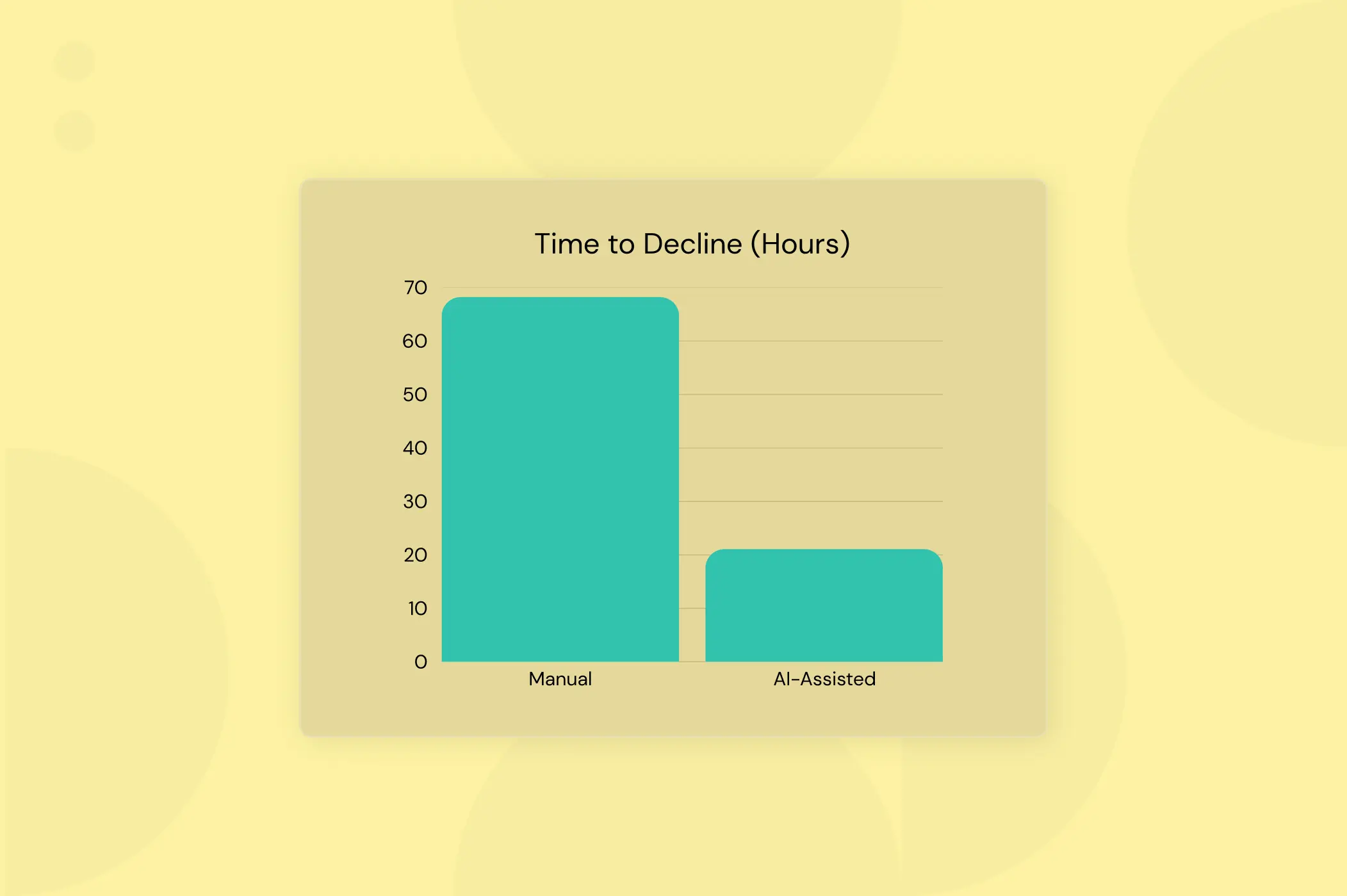
When an interviewer ignores a meeting invite, that slot is effectively dead until they respond. On manual teams, interviewers sit on declines for an average of 68 hours, nearly three full days. The coordinator cannot offer that time to another candidate. The pipeline stalls. The candidate waits. By the time the decline finally comes through, rescheduling requires starting over from scratch. AI-powered coordination cuts that response time to 21 hours by proactively chasing interviewers via Slack and email, forcing a decision rather than waiting for one. That single improvement, compounded across every interview loop, has a larger impact on time-to-hire than most TA leaders realize.
The capacity gains are significant too. A manual recruiting coordinator handles roughly 30 interviews per week at full capacity. A coordinator using AI-powered scheduling handles 158 per week, because 46% of coordination tasks are handled autonomously and an additional 26% are completed by candidates through self-service. The coordinator's time goes to the 28% that genuinely requires human judgment.
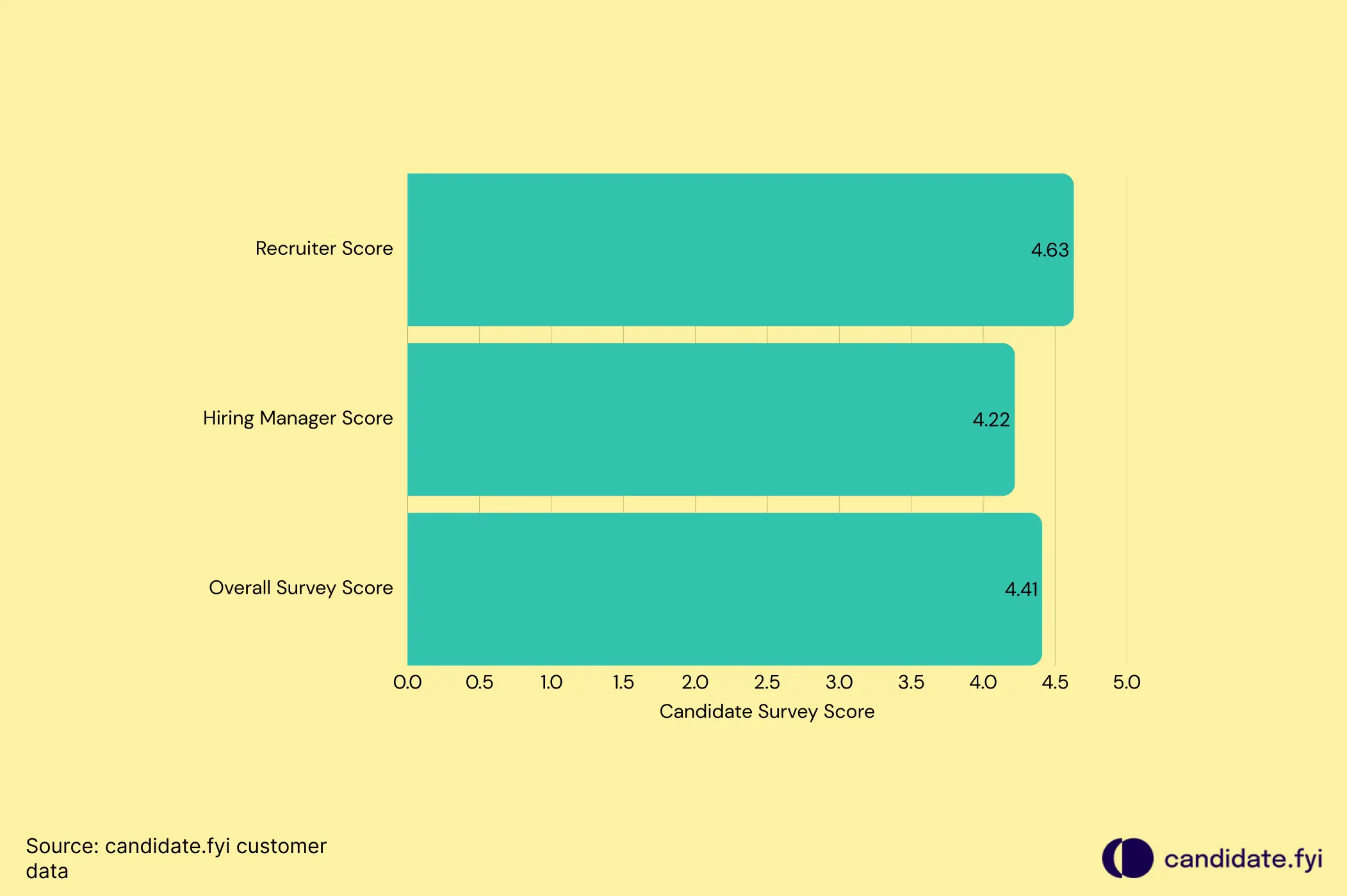
There is also a candidate experience argument that is sometimes overlooked. The assumption in the industry is that automation makes the hiring process feel cold. The data says otherwise. Recruiter screens, the most automated step in the process, score 4.63 out of 5 in candidate satisfaction. Hiring manager interviews, which involve more manual coordination and more rescheduling, score lower at 4.22. Speed and consistency, delivered through automation, translate directly into a better candidate experience.
How Do You Build a Recruiting Automation Stack Without Overhauling Your ATS?
The first principle: automation amplifies what already exists. If your interview loops are inconsistent, automated scheduling will make those inconsistencies faster and more visible. Process has to come before tooling.
For TA leaders at Level 3 maturity and above, where coordination is centralized and processes are documented, building a recruiting automation stack follows a clear sequence.
Start with interview scheduling. It is the highest-volume, most manual part of the coordination workflow, and it has the most direct impact on both coordinator capacity and candidate experience. A platform that handles candidate self-scheduling, panel construction, interviewer pool management, and ATS sync in one place is the core of the stack.
Layer in automated candidate communication next. Confirmation emails, reminders, and prep materials should trigger automatically off scheduling milestones. This eliminates the most repetitive coordinator work and closes the communication gap that drives candidate ghosting.
Add AI tools for job description creation and feedback consolidation as your team's familiarity with AI-assisted workflows grows. These workflows have longer change management curves because they involve hiring managers and recruiters directly, not just coordinators.
The integration layer matters more than the individual tools. A recruiting automation stack where scheduling, ATS updates, and candidate communication all connect without manual handoffs is what creates compounding efficiency gains. Without integrations, each tool solves a local problem but creates new coordination overhead at the seams.
What Are the Most Common Mistakes When Implementing Recruiting Automation?
Three patterns show up repeatedly when enterprise TA teams struggle with automation adoption.
The first is automating broken processes. A team that introduces self-scheduling before standardizing their interview loops will automate the inconsistency. Candidates book interviews with panelists who lack the right training, or at times that conflict with internal load-balancing rules. The automation works exactly as designed. The process design was the problem. Document and standardize first.
The second is skipping centralized ownership. Recruiting automation requires someone to own the system: monitoring for exceptions, adjusting interviewer pools, ensuring ATS integrations are healthy, and training coordinators on what the AI handles versus what needs human review. Teams that deploy automation without assigning that ownership see performance degrade quickly as edge cases accumulate.
The third is treating automation as a solution to people problems. If a hiring manager consistently ignores interview requests, an automated chaser will force a faster decision, but the underlying behavior still needs to be addressed. Automation narrows the gap created by slow human response times. The Wrapped Report shows AI reduces interviewer decline response time from 68 hours to 21 hours. That is a meaningful improvement. It is not a substitute for manager accountability.
How Should TA Leaders Evaluate Recruiting Automation Tools?
Five questions worth asking any vendor in this category:
Does the platform handle exceptions, or just the happy path? Ask specifically how the tool responds when an interviewer declines, when a panel needs to be rebuilt, or when a candidate reschedules. Tools that handle only standard bookings will fail at enterprise scale.
How does it integrate with your ATS? Bi-directional sync matters. Scheduling updates should write back to your ATS automatically without coordinator intervention. Ask whether the integration is native or requires a third-party connector, and what happens when the connection breaks.
What does the candidate experience look like? Ask to see the candidate-facing portal. Branded, clear, and accessible candidate communication is part of what drives satisfaction scores. Candidates should be able to view their schedule, access prep materials, and reschedule without emailing a coordinator.
How does the platform handle interviewer load balancing? Enterprise teams have interviewers who over-index on panel requests. A good scheduling tool enforces capacity rules automatically, protecting interviewer experience and preventing coordinator burnout from constant exception management.
What does the support and onboarding model look like? Recruiting automation involves change management across recruiters, coordinators, and hiring managers. Vendors who treat implementation as a hand-off rather than an ongoing partnership create adoption problems. Ask for specifics on onboarding timelines and dedicated support access.
Q&A
What is recruiting automation?
Recruiting automation is the use of software and AI to handle repetitive tasks in the hiring process, including interview scheduling, candidate communication, job description creation, feedback collection, and resume screening. The goal is to reduce manual coordination time so talent acquisition teams can focus on strategic work.
What recruiting tasks can be automated?
The six most commonly automated workflows in enterprise recruiting are: interview scheduling, candidate communication (confirmations, reminders, prep materials), job description drafting, interviewer feedback consolidation, candidate pulse surveys, and applicant screening and ranking. Interview scheduling delivers the highest ROI because it is the most time-intensive manual workflow and the one where automation produces the largest capacity gain.
How does recruiting automation improve candidate experience?
Automated recruiting improves candidate experience by eliminating communication delays, providing real-time interview details through a centralized candidate portal, and reducing the number of reschedules caused by manual coordination errors. Candidate satisfaction data shows that recruiter screens, the most automated interview type, score higher (4.63/5) than hiring manager interviews, which involve more manual coordination (4.22/5).
What is the ROI of recruiting automation for enterprise teams?
The most direct ROI metric for interview scheduling automation is decline response time: AI coordination cuts the time interviewers take to respond to a decline from 68 hours to 21 hours, keeping pipelines moving instead of stalling in a dead zone. Coordinator capacity increases 5x (from 30 to 158 interviews per week), time-to-schedule drops from 243 minutes to 27 minutes, and time-to-interview improves from 5.9 days to 3.9 days. Across a team running hundreds of interviews per week, those gains compound into measurable reductions in time-to-hire and improvements in offer acceptance rates.
More Articles
What Is Hiring Velocity? The Formula, the Three Waits and the Benchmarks
Most hiring teams know their time to fill and almost none know where the days inside it go. Hiring velocity breaks every interview stage into three waits, to book, to interview and to decide. Here is the formula and what it looks like across 2.4 million completed stages.

candidate.fyi vs Calendly for Recruiting Teams
Calendly matches calendars. Automated interview scheduling has to build panels, sync with your ATS, and manage candidate communication. See where Calendly breaks down for recruiting teams and what candidate.fyi does differently.

12 Key Metrics to Track Interview Coordination Efficiency
Want to improve interview scheduling efficiency? Track these 12 key recruiting ops metrics to optimize coordination and candidate experience. Learn more!