9 AI Recruiting Workflow Automation Features for Panel Interviews and Workday

Quick answer
The 9 AI scheduling features that matter most for panel interviews and Workday include full AI coordination, panel orchestration, native ATS integration, multi-timezone logic, interviewer load balancing, autonomous rescheduling, candidate self-scheduling, real-time interviewer replacement, and interview intelligence. candidate.fyi's fyi agent is the only platform that delivers all 9 in a single coordination layer—resolving 82% of scheduling sessions without human intervention.
Why panel interviews break recruiting workflows
A single panel screen—three interviewers, two time zones, one candidate—can consume an hour of coordinator time before a single invite goes out. Add Workday to the mix, and now you're manually syncing confirmations back into your ATS while fielding decline notifications and last-minute changes simultaneously.
That's Calendar Tetris. And it's the top operational burden for recruiting coordinators today—38% cite interview scheduling as their single biggest pain point (candidate.fyi's 2026 Agentic TA Operations Blueprint). Application volumes are up 32%, 62% of HR teams are already operating beyond capacity, and the 14% industry-wide reschedule rate isn't going down.
AI recruiting workflow automation changes this math—but only if the platform actually handles the hard parts. Here are the 9 features that separate genuine AI coordination from a glorified calendar link.
Feature 1: Full AI coordination layer
Most scheduling tools automate one thing: sending the invite. A full AI coordination layer automates the entire workflow—from ATS stage change to confirmed interview, including every exception along the way.
candidate.fyi's fyi is built as this coordination layer. When a candidate advances in your ATS, fyi triggers automatically: it assembles the panel, checks availability, applies time-zone logic, selects interviewers based on load, and sends a branded self-scheduling link—all without a coordinator touching it. When things change (a decline, a conflict, a candidate reschedule), fyi handles the recovery autonomously.
The result: 82% of scheduling sessions resolved without human intervention. fyi handles 46% of all scheduling tasks end-to-end; candidates self-serve 26%; coordinators only touch the remaining 28%—the genuinely complex cases that need human judgment.
GoodTime and Paradox automate scheduling tasks but escalate more frequently to coordinators. ModernLoop focuses primarily on the scheduling action itself rather than end-to-end workflow coordination. The difference shows up in coordinator headcount and time-to-fill, not just feature checklists.
Explore: Interview Scheduling · fyi AI Agent · Recruiting Coordination · Book a Demo
Feature 2: Panel interview orchestration
Scheduling one interviewer is a solved problem. Scheduling four simultaneously—checking individual availability, finding a shared window, handling a decline from one panel member after invites go out—is where most platforms break down and hand the problem back to a coordinator.
True panel orchestration means the AI assembles the panel, finds the overlap window across all interviewers, sends coordinated invites, and manages any post-invite disruption autonomously. For a 4-person panel spanning New York, London, and Singapore, fyi does all of this without coordinator input. candidate.fyi's 2025 platform data shows Monday is 40% more chaotic than any other day for interviewer declines—fyi's autonomous recovery handles exactly that disruption.
Manual panel coordination for 50 interviews takes approximately 12 hours. With AI orchestration: 30 minutes (candidate.fyi 2026 Agentic TA Operations Blueprint).
Feature 3: Native Workday integration
A scheduling tool that doesn't sync back to your ATS creates a second system of record—and more manual work, not less. Native Workday integration means scheduling triggers automatically when a candidate advances in Workday, and confirmed interviews write back to Workday without anyone touching it.
candidate.fyi's native Workday integration does exactly this. Your ATS stays the source of truth. Stage changes kick off scheduling automatically. Confirmed interview data—interviewer, time, format—flows back into the candidate record. Your Workday admin configures it in roughly a half-day; no ongoing maintenance required.
This matters especially for enterprise teams where coordinators are expected to keep Workday current. Without native integration, every confirmed interview requires a manual update. With it, the loop closes automatically.
Feature 4: Multi-timezone scheduling intelligence
Finding a shared availability window across interviewers in multiple time zones sounds like a calendar problem. It's actually a reasoning problem—accounting for business hours, local preferences, interviewer travel, and candidate location simultaneously.
fyi applies time-zone logic automatically during panel assembly. It doesn't surface every possible slot—it surfaces the right ones, accounting for interviewer context. For global enterprise teams where a single panel might span three continents, this eliminates the 30–60 minutes a coordinator would otherwise spend manually cross-referencing calendars.
candidate.fyi's 2025 platform data shows self-scheduling averages 26.80 minutes from invite to confirmed slot. Availability-based manual coordination averages 243.19 minutes—a 9x difference that compounds across every open role in your pipeline.
153 Interviews Per Coordinator, Per Week.
The average team manages 38 manually. candidate.fyi's AI coordination layer gives your team 4x the capacity — without adding headcount.
Feature 5: Interviewer load balancing
Without load balancing, the same five willing interviewers get scheduled for everything while the rest of the interviewer pool sits idle. Over time this creates burnout, interview quality degradation, and a bottleneck that slows down every open role.
AI load balancing selects interviewers based on recent interview volume, not just availability. fyi applies this logic automatically during panel assembly—distributing interviews equitably across your pool without a coordinator manually tracking who's been scheduled too much this week. Enterprise teams with large interviewer pools see measurably better spread and fewer interviewer complaints about scheduling overload.
GoodTime includes load balancing functionality. ModernLoop also covers this. Where candidate.fyi differs is that load balancing is applied as part of autonomous orchestration—not a setting a coordinator has to remember to configure per requisition.
Feature 6: Autonomous rescheduling and decline recovery
A 14% reschedule rate is the industry norm (candidate.fyi Recruiting Coordination Wrapped 2025). That means roughly 1 in 7 confirmed interviews requires recovery—finding a new time, a new interviewer, or both, and re-communicating with the candidate. On a Monday morning with a full pipeline, that's hours of reactive coordination work.
Autonomous rescheduling means the platform detects a decline or cancellation and resolves it without coordinator involvement. fyi receives the decline signal, identifies a suitable replacement interviewer or alternative slot, and re-sends the invite to the candidate—all before a coordinator has seen the original notification. The benchmark response time drops from 68 hours (manual) to roughly 20 hours with AI assistance, and fully autonomous recovery happens in minutes.
This is one of the highest-ROI features in the stack because it directly removes the most reactive, interruptive work from a coordinator's day.
Feature 7: Candidate self-scheduling
Candidate self-scheduling—giving candidates a link to choose their own interview time—is table stakes at this point. The differentiator is how fast it happens and how well it's designed.
candidate.fyi's self-scheduling portal averages 26.80 minutes from invite receipt to confirmed slot. The portal is branded, mobile-friendly, and handles the candidate's time zone automatically. More importantly, it's connected to the coordination layer—when a candidate selects a time, fyi confirms all interviewers, sends calendar holds, and logs the event back to Workday in the same motion.
Speed matters here more than most teams realize. candidate.fyi's 2025 data shows time-to-interview is 3.9 days with self-scheduling vs. 5.9 days with availability-based scheduling. Across a 200-person hiring plan, that's weeks of aggregate pipeline compression.
Feature 8: Real-time interviewer replacement
An interviewer cancels two hours before the interview. The candidate is confirmed. The coordinator is in another meeting. What happens?
Without real-time replacement capability, this either delays the interview or falls on whoever picks up the Slack message first. With it, the platform detects the cancellation, identifies a qualified replacement from the interviewer pool, gets confirmation, updates the candidate, and re-sends calendar invites—all autonomously.
fyi handles same-day interviewer replacements as part of its core coordination loop. This is distinct from rescheduling: the interview time stays the same, the interviewer changes. It's a harder problem that requires real-time availability checking, interviewer qualification matching, and candidate communication in a compressed window. Teams running high-volume pipelines find this feature disproportionately valuable.
Feature 9: Interview intelligence and feedback coordination
Scheduling is the beginning of the interview workflow, not the end. After the interview happens, someone needs to collect feedback, chase down missing scorecards, and synthesize interviewer input into a hiring decision. Without automation, this is another round of manual follow-up that can add days to time-to-offer.
candidate.fyi's Interview Intelligence layer handles post-interview coordination: automated feedback reminders, scorecard collection, and debrief scheduling. It closes the loop that most scheduling-only tools leave open. The platform tracks completion rates and escalates to hiring managers when feedback is missing—removing the coordinator from the chase entirely.
This is what separates a scheduling tool from a full AI coordination platform: coverage across the entire interview workflow, not just the calendar invite.
How to evaluate AI scheduling platforms against these 9 features
Not every platform covers all 9. Here's a quick checklist to run through any tool you're evaluating:
* Does it trigger from ATS stage changes automatically? (Full coordination layer)
* Can it orchestrate 3+ interviewers simultaneously without coordinator input? (Panel orchestration)
* Does confirmed interview data write back to Workday? (Native ATS integration)
* Does it find overlap windows across time zones automatically? (Timezone intelligence)
* Does it distribute interviews across the interviewer pool equitably? (Load balancing)
* When a decline comes in, does it recover without a coordinator? (Autonomous rescheduling)
* How fast does a candidate go from invite to confirmed slot? (Self-scheduling—benchmark: 26.80 min)
* Can it replace a same-day interviewer cancellation in real time? (Real-time replacement)
* Does it collect and chase down post-interview feedback automatically? (Interview intelligence)
FAQ
What is AI recruiting workflow automation?
AI recruiting workflow automation uses AI agents to handle end-to-end interview coordination—from candidate advancement in your ATS through scheduling, confirmation, rescheduling, feedback collection, and ATS sync—without manual coordinator intervention at each step.
What AI scheduling features matter most for panel interviews?
Panel interviews specifically require simultaneous multi-interviewer coordination, conflict resolution after invites go out, time-zone overlap logic, load balancing, and real-time replacement when an interviewer cancels. These are the features that break down in basic scheduling tools and require genuine AI orchestration to handle autonomously.
How does AI interview scheduling integrate with Workday?
Native Workday integrations trigger scheduling automatically when a candidate advances to the interview stage, and write confirmed interview data back to the ATS without manual sync. candidate.fyi's native Workday integration handles this end-to-end—your Workday admin configures it in roughly a half-day with no ongoing maintenance required.
Can AI scheduling tools handle multi-time-zone panel interviews?
Yes—platforms with multi-timezone intelligence find overlap windows across global interviewer pools automatically. candidate.fyi's fyi applies time-zone logic during panel assembly regardless of where interviewers are located, eliminating the 30–60 minutes a coordinator would otherwise spend manually cross-referencing availability.
How do I know if my team needs all 9 features?
If your team runs panel interviews, uses Workday, has interviewers in multiple time zones, or has a reschedule rate above 10%, you need most of them. candidate.fyi's 2025 data shows coordinators without AI support average 38.77 interviews per week; with a full AI coordination layer, that climbs to 153.44—a 5x capacity multiplier.
What's the difference between a scheduling tool and a full AI coordination layer?
A scheduling tool sends invites. A full AI coordination layer—like candidate.fyi's fyi—triggers from ATS stage changes, assembles panels, balances interviewer load, handles declines, reschedules autonomously, replaces interviewers in real time, communicates with candidates, syncs to your ATS, and collects post-interview feedback. The difference is how much of your coordinator's day disappears.
Bottom line
The 9 features in this guide aren't a wish list—they're the table stakes for enterprise recruiting teams running panel interviews at scale with Workday as their ATS. Most platforms cover some of them. candidate.fyi's fyi covers all of them in a single coordination layer that resolves 82% of scheduling sessions without a coordinator touching it.
Teams using the platform schedule 5x more interviews per coordinator per week, compress time-to-interview by 9x on self-scheduled roles, and eliminate the Monday morning Calendar Tetris that's been draining coordinator capacity for years.
See what that looks like for your team: Book a demo or run your numbers through the ROI calculator.
More Articles
Candidate Fraud Is an Interview Problem, Not a Background-Check Problem
Candidate fraud gets treated as a background-check failure, caught after the offer. But the interview is the only stage where anyone observes the candidate in real time, and remote-first hiring removed that check without anyone deciding to. This guide covers where fraud actually surfaces in a loop, what interviewers can and cannot verify, and the four coordination changes that make it detectable.
Recruitment Technology, and Where AI Actually Sits in the Stack
Every recruiting tool now claims AI, but the stack is still a set of separate layers, from the ATS through scheduling, interview intelligence and reporting. This guide shows which layer each AI claim belongs to, where the time in hiring actually goes, and where to start modernizing.
AI Scheduling vs. Self‑Service Links: Which Delivers Better Candidate Experience?
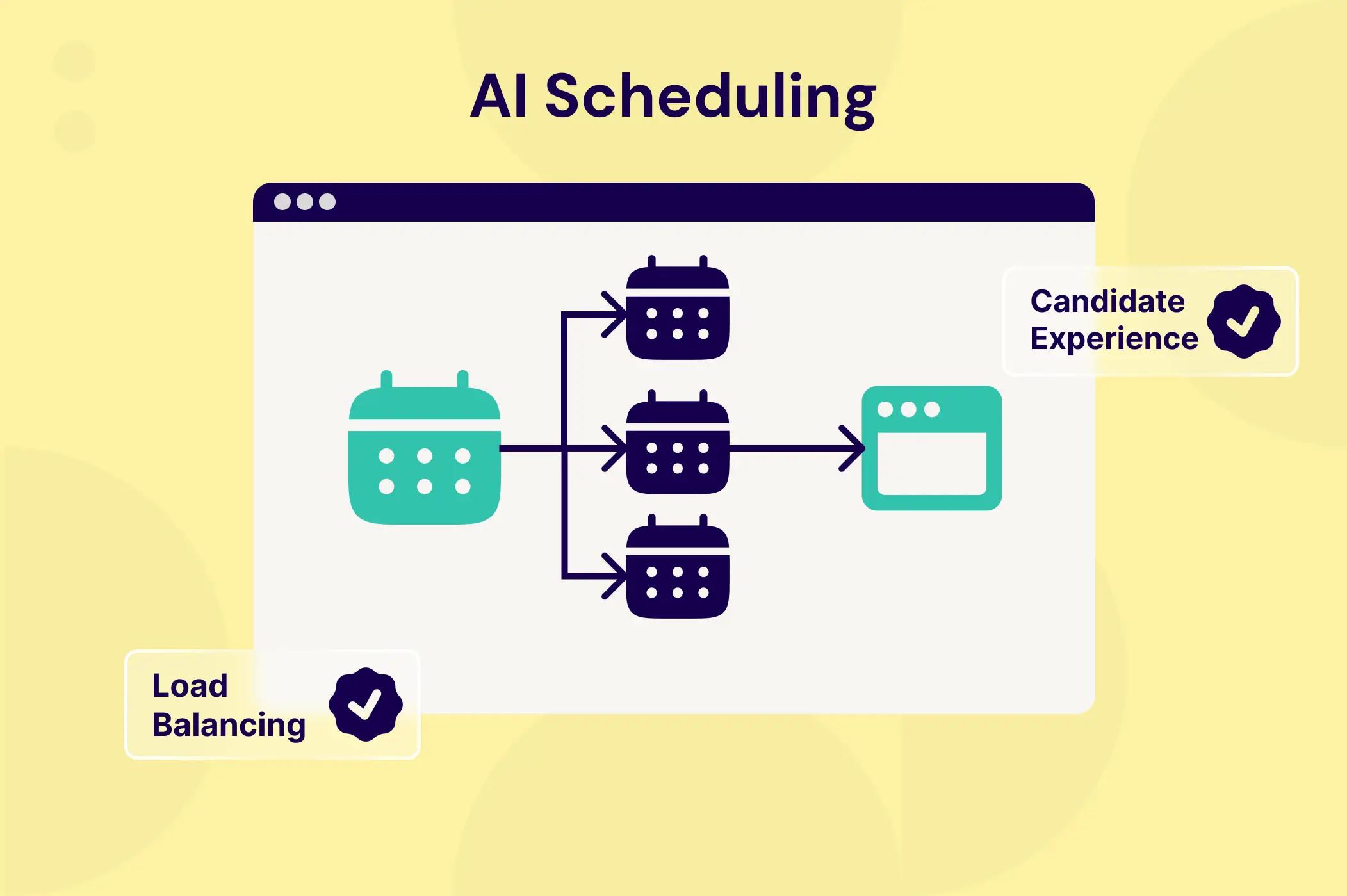
Booking links feel like a quick win because they eliminate the initial email tag. However, treating enterprise hiring like a simple calendar transaction creates hidden costs around interviewer burnout and disjointed candidate experiences.