Talent Acquisition Trends, and What They Change About the Interview Week


Quick answer
The talent acquisition trends heading into 2027 all land in the interview week. Agents are taking over coordination, fraud checks have moved into the interview itself, interview intelligence is becoming standard with consent as the open question, and teams are swapping time-to-fill for hiring velocity. In candidate.fyi data, 64% of an interview stage is waiting for the interview date.
Look at what shipped in recruiting over two weeks this October.
On October 15, background check company Checkr published a survey of 3,000 US hiring managers: 40% had interviewed a candidate later found to be using a fake identity, up from 31% a year earlier. On October 20, ICIMS announced a Hiring Agent that works inside Microsoft Teams. On October 23, Dayforce agreed to acquire Ribbon AI, a conversational interviewing company, and Paylocity launched a recruiting extension with two AI agents. On October 27, candidate.fyi launched its agentic hiring platform.
Different companies, different buyers. But nearly every one of those announcements is about the same stretch of the hiring process: the week between "let's get this candidate in" and "we've made a decision." That is where agents are being pointed, where fraud is being caught, where interviews are being recorded, and where most of the time in hiring actually goes.
This guide reads the current talent acquisition trends through that week. It covers four: agents, candidate fraud, interview intelligence and hiring velocity. It stays off sourcing and employer brand, and off the definitions, which we covered in talent acquisition vs recruitment and where AI sits in the recruitment stack. For each trend, it covers what launched, what the data says, and what it changes about how a team runs interviews.
Trend 1: Agents are taking over the coordination work
Featured snippet
The biggest talent acquisition trend of late 2026 is AI agents that own recruiting jobs instead of assisting with them. Recent launches from ICIMS, Paylocity, Dayforce and candidate.fyi all point agents at the same work: scheduling, candidate questions, follow-ups and moving hiring actions forward. Recruiters still make the hiring decisions. The agents take the logistics around them.
A year ago, most AI in recruiting was a writing assistant. It drafted job descriptions, summarized resumes and suggested outreach. The launches this fall look different. Each one hands an agent a piece of the process and lets it run.
* ICIMS Hiring Agent (announced October 20) works inside Microsoft Teams. Recruiters and hiring managers review candidates, capture feedback and approve hires there, and the agent sends alerts to keep candidates from stalling. ICIMS puts the boundary plainly: "The agent prioritizes and prompts, but recruiters and managers always make the call." The same release added a candidate.fyi integration for interview management.
* Paylocity Recruiting Optimizer (October 23) launched with a Candidate Engagement Agent that answers applicant questions over web and SMS and can help schedule interviews against recruiter-set criteria, plus a Talent Rediscovery Agent for past applicants.
* Dayforce and Ribbon AI (October 23). Dayforce plans to fold Ribbon's voice and video screening interviews into its agentic recruiting experience. Ribbon reports more than one million completed interviews, and an AI scheduling agent is on its roadmap.
* candidate.fyi (October 27) launched Recruiting Coordination, Candidate Experience and Interview Companion Agents, run by an operator agent called fyi, on top of the ATS a team already has. The Talent Collective covered the shift in Beyond the Prompt: Why Recruiting AI Has Moved From Assistants to Agents.
Gartner's view of 2026 points the same way. It expects high-volume recruiting to go AI-first, and it expects recruiters' value to shift toward complex hiring as AI absorbs the routine work. The routine work, in most teams, is the interview week: collecting availability, booking panels, chasing confirmations, fixing reschedules and answering "what happens next?"
What it changes about the interview week. The coordinator's day stops being a queue of scheduling requests and becomes a queue of exceptions the agent could not handle. That only works if the team decides up front what the agent handles alone and what it brings back. The useful test for any of these products is simple: hand the agent a requisition and a deadline, then change something halfway through. We went deeper on that in agentic AI in recruiting and AI scheduling assistants and the interview loop.
Trend 2: Candidate fraud checks are moving into the interview
Featured snippet
Candidate fraud is now a talent acquisition workflow problem. In Checkr's 2026 survey of 3,000 US managers, 40% had interviewed someone using a fake identity, and 68% said candidates fake identities with AI faster than teams catch them. Vendors are responding by putting identity and deepfake checks inside screening and interviews, not after the offer.
The Checkr numbers are worth reading together. Interviews with fake identities rose from 31% to 40% in a year. 68% of managers believe job seekers are better at faking identity with AI than hiring teams are at catching it. Only 23% are extremely confident their process would catch a fraudulent candidate. And 63% of organizations focus their fraud prevention mainly before the hire, while 44% have no formal, written process for verifying identity after it.
Gartner has made two predictions that sit behind the same trend. It expects one in four candidate profiles worldwide to be fake by 2028. And it expects that by 2027, 75% of hiring processes will include certifications and tests for workplace AI proficiency, partly in response to candidates using generative AI in applications.
The launches followed. ICIMS's fall release added candidate fraud detection integrations, starting with Socure and ApplicantX. Ribbon's interviews include integrity checks that flag unusual audio, gaze or response-timing patterns. candidate.fyi launched Candidate Integrity alongside its agents, with passive checks on how candidates reach the portal and active checks on recorded interviews for impersonation, deepfakes and outside help. The common design choice is that the checks inform the team rather than reject the candidate.
What it changes about the interview week. The first live call is now a checkpoint, whether or not anyone assigned it that role. Teams need to decide who looks at a fraud signal, at which stage, and what happens next, because a flag nobody owns is just a notification. The question to settle is less "do we check?" and more "where in the loop, and who decides?" We broke down the specific points where a fake gets through in candidate fraud is an interview problem and candidate screening.
153 Interviews Per Coordinator, Per Week.
The average team manages 38 manually. candidate.fyi's AI coordination layer gives your team 4x the capacity — without adding headcount.
Trend 3: Interview intelligence is becoming the default, and consent is the buying question
Featured snippet
Interview intelligence, meaning AI that records, transcribes and summarizes interviews, is becoming standard in talent acquisition. The open questions have shifted from transcript quality to two others: how candidates are told about recording and asked for consent, and whether the notes reach the next interviewer and the debrief instead of sitting in a separate tool.
AI in the interview room now comes in two forms. Notetakers join live interviews, capture what was said and draft feedback. Conversational interviewers, like Ribbon's, run the screening conversation themselves and score it from the transcript. Both are spreading fast, and both create a record of the candidate that did not exist before.
That record is where the scrutiny is landing. Two AI meeting notetaker companies are facing privacy suits in federal court in Northern California. The consolidated Otter.ai case, filed in 2025, is waiting on a ruling on Otter's motion to dismiss. A class action against Granola, filed July 30, 2026, alleges the app captures meeting participants without notifying them. Neither case has been decided, and the claims are allegations. But recruiting teams are paying attention, because an interview is a meeting with someone outside the company who did not pick the tools.
What it changes about the interview week. Two decisions move earlier. The first is consent: whether recording is on unless the candidate opts out, or off until they opt in, and where the candidate hears about it. The second is where the notes go. A transcript that only the interviewer opens does not help the round three interviewer or the debrief. We made that case in interview intelligence, and why the notes have to follow the candidate, and covered how structured feedback holds up in interview scorecards.
Trend 4: Hiring velocity is replacing time-to-fill
Featured snippet
Hiring velocity measures where the time goes in each interview stage, not just how long a hire took. Every stage has three waits: time to book, time to interview and time to decide. In candidate.fyi data across 2.4 million completed stages, a typical stage takes about a week, and 64% of it is waiting for the interview date.
Time-to-fill tells a team how long hiring took. It does not say why. As agents take on scheduling, teams need a measure that shows whether the work actually got faster, and which part of it.
That was the point of The Hiring Velocity Framework, built on 7.72 million applications and 2.4 million completed stages on the candidate.fyi platform between September 2025 and August 2026. A few findings stand out for the interview week:
* A typical stage takes about a week. It is booked in about 20 hours, held about five days later (4.9 days median) and decided about a day and a half after that.
* Booking is the smallest wait. Time to book is 13% of a stage, time to decide is 23%, and time to interview is 64%.
* How candidates book matters. Self-booking takes about 4 hours to book at the median, against about 28 hours when a team sends an availability request. About 1 in 9 self-booking candidates never respond, against about 1 in 3 for availability requests.
These are associations, not a controlled test, and they only cover teams already using scheduling software, so manual processes are likely slower. But they change where a team looks. Faster booking helps. The bigger lever is the gap between booking and the interview itself, which usually comes down to interviewer availability.
What it changes about the interview week. Teams that report only time-to-fill should add the three waits per stage. That turns "hiring is slow" into "stage two waits five days for an interviewer," which is something a team can fix. The full method is in what is hiring velocity.
How to act on these trends this quarter
Featured snippet
To act on current talent acquisition trends, start where your team loses the most time. Pilot a coordination agent on one team with a time-to-interview target. Assign an owner for fraud signals at each stage. Decide your interview recording consent model before buying a notetaker. Add time to book, time to interview and time to decide to your reporting.
Not every trend needs a project. Pick the one that matches the problem your team already has.
* If coordinators spend most of their week on scheduling: start one agent on one team. Give it a time-to-interview target per role and decide which situations it handles on its own.
* If you run remote first-round screens: map where identity gets checked today, name who reviews a flag at each stage, and make sure a flag informs a person rather than rejecting a candidate automatically.
* If interviewers type their own notes: choose your consent model and how candidates are told about it, then evaluate tools on where the notes go after the call.
* If you only report time-to-fill: add the three waits per stage for one month and find the stage with the longest wait for the interview date.
* If leadership wants more hiring without more headcount: measure the coordination load first. The four trends above all promise capacity, and the baseline is how you will know whether you got it.
Frequently asked questions
What are the biggest talent acquisition trends for 2027?
Four trends are shaping talent acquisition heading into 2027: AI agents taking over interview coordination and candidate communication, candidate fraud checks moving into screening and interviews, interview intelligence becoming standard with more attention on consent, and teams measuring hiring velocity by stage instead of relying on time-to-fill alone.
How is AI changing talent acquisition?
AI in talent acquisition is moving from assistants that draft and summarize to agents that own a job, such as scheduling interviews, answering candidate questions or capturing interview notes. Recruiters and hiring managers keep the hiring decisions. The work that shrinks is the logistics between those decisions.
How common is candidate fraud in hiring?
It is common and rising. In Checkr's 2026 survey of 3,000 US hiring managers, 40% said they had interviewed a candidate later found to be using a fake identity, up from 31% in 2025. Gartner predicts that one in four candidate profiles worldwide will be fake by 2028.
What is hiring velocity?
Hiring velocity is a way of measuring how fast candidates move through each interview stage, split into three waits: time to book the interview, time until the interview happens and time to decide. It shows where hiring time goes, which time-to-fill on its own does not.
Will AI agents replace recruiting coordinators?
No. Agents take on the repetitive coordination work, like collecting availability, booking panels and handling reschedules. Coordinators shift to the exceptions, candidate relationships and complex loops. The goal is more interviews handled per coordinator, not fewer coordinators.
The bottom line
The talent acquisition trends that matter right now are not spread evenly across hiring. They are concentrated in the interview week, where scheduling, identity, interview records and waiting time all collide. Teams that treat them as one set of decisions about that week will get more from them than teams that buy a tool for each.
candidate.fyi was built for that week. Its Recruiting Coordination, Candidate Experience and Interview Companion Agents run on top of the ATS a team already has, and Candidate Integrity adds fraud checks where interviews happen. See how it works at candidate.fyi/fyi, or book a demo and bring the interview loop that took the longest last quarter.
More Articles

12 Key Metrics to Track Interview Coordination Efficiency
Want to improve interview scheduling efficiency? Track these 12 key recruiting ops metrics to optimize coordination and candidate experience. Learn more!
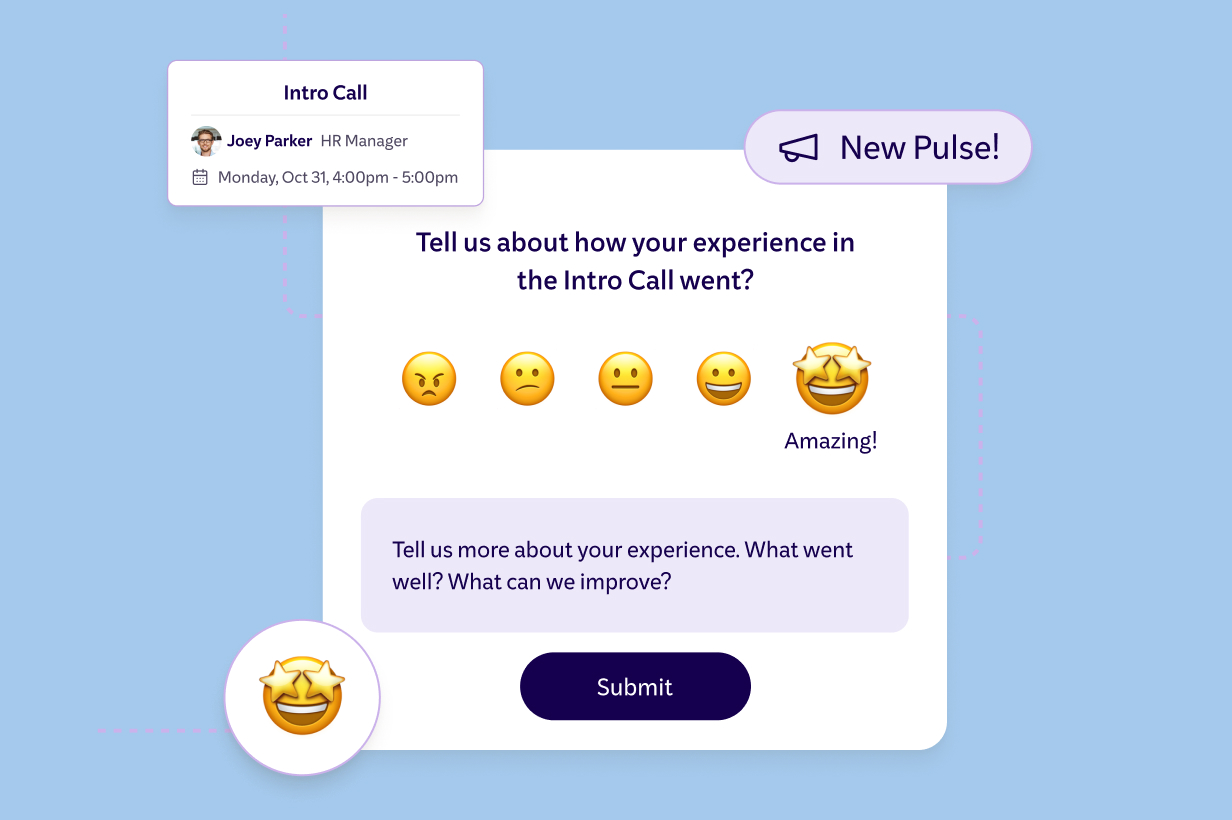
Optimizing Your Hiring Process: A Guide to Crafting the Ultimate Candidate Experience Survey
A well-crafted candidate experience survey provides you with the insights needed to refine your recruiting approach and bolster your company’s reputation.

What Is Recruiting Automation? A Practical Guide for Enterprise TA Teams
Recruiting automation covers 6 key workflows. Learn how enterprise TA teams use it to schedule 5x more interviews and cut manual admin by 46%.