9 AI Interview Scheduling Tools for Fast Hiring (2026)

Quick answer
The best AI interview scheduling software handles the full coordination loop — not just a self-scheduling link. candidate.fyi resolves 82% of scheduling sessions without human intervention, giving coordinators 5x more weekly capacity.
Scheduling an interview used to take a few minutes. Now it takes 7–18 hours — chasing availability, syncing panels, absorbing last-minute declines. Recruiters call it Calendar Tetris. And the math is getting worse: applications per recruiter are up 411.8% since 2022 while recruiter headcount fell 55.6%, per Greenhouse benchmark data.
AI interview scheduling software doesn't just send calendar invites faster. The best platforms act as a coordination layer — monitoring your ATS, triggering scheduling the moment a candidate advances, handling reschedules autonomously, and escalating only what actually needs a human. The difference between a self-scheduling link and a true AI agent is the difference between saving 30 minutes and recovering 10–20 hours per recruiter per week.
This post ranks 9 tools by AI depth, time zone handling, coordinator workload reduction, and ATS integration quality — the criteria that matter for talent acquisition teams scaling without adding headcount.
What Is AI Interview Scheduling Software?
Featured snippet
AI interview scheduling software automates the coordination of job interviews — from sending invites and syncing calendars to handling reschedules and time zone conflicts. AI-native platforms go further: they trigger scheduling automatically when a candidate advances in your ATS, resolve conflicts without human input, and give coordinators 5x more capacity than manual methods.
Interview scheduling software has existed for years. Most of it is just self-scheduling links — you send a URL, the candidate picks a slot, the calendar updates. That's not AI coordination; that's a form.
True AI interview scheduling software works differently. It reads your ATS. When a candidate moves to the interview stage, the system kicks off automatically — no manual trigger, no coordinator action required. It builds the panel, checks availability across interviewers and time zones, sends the invite, and monitors for declines. When something breaks (and it will — the 14% reschedule rate is structural, not fixable with process), the AI rebuilds the schedule without waiting for someone to notice the conflict.
candidate.fyi's platform data across 257,946 scheduling events shows self-scheduling resolves in 26.80 minutes on average. Coordinator-managed scheduling takes 243.19 minutes — nine times longer. That gap is where AI scheduling software lives.
How We Evaluated These 9 Tools
Featured snippet
We evaluated these AI interview scheduling tools on five criteria: AI automation depth, ATS integration quality, time zone and panel handling, candidate experience, and enterprise scalability. Tools that require manual triggers for every scheduling action ranked lower than those that operate autonomously the moment an ATS stage changes.
Every vendor in this category claims "AI-powered" scheduling. Most mean they have a self-scheduling link and some calendar sync. The distinction matters when you're running 150+ interviews a week.
Our five evaluation criteria: AI automation depth (does the system operate without manual triggers?), ATS integration (does it read and write back to your ATS in real time?), time zone and panel handling (can it find mutual availability across global panels?), candidate experience (do candidates get clear, timely communication at every step?), and enterprise scalability (can it handle a volume spike without breaking down?).
The 9 Best AI Interview Scheduling Tools
Featured snippet
The best AI interview scheduling tools for enterprise recruiting teams in 2026 are candidate.fyi, GoodTime, Paradox, ModernLoop, HireVue, Calendly, Cronofy, Gem, and Spark Hire. Each addresses a different slice of the problem, from high-volume frontline hiring to complex multi-panel engineering loops and deep ATS integration.
1. candidate.fyi
candidate.fyi is built for enterprise recruiting teams that need more than a scheduling link — they need the entire coordination layer automated.
The platform's AI agent, fyi, acts as the intelligence layer between your ATS and your interviewers. When a candidate advances in Workday, Greenhouse, or Lever, fyi triggers scheduling automatically. It builds the panel, checks availability across time zones, sends the invite, and monitors for changes. When an interviewer declines the night before, fyi responds — not your coordinator at 7am.
The numbers: candidate.fyi resolves 82% of scheduling sessions without human intervention. Coordinators using the platform handle 153 interviews per week on average, vs. 38 without AI assistance — a 5x capacity multiplier. Self-scheduling sessions resolve in 26.80 minutes. Availability-based scheduling: 243.19 minutes. The gap represents thousands of recovered hours per year.
For teams on Workday specifically, scheduling kicks off the moment a candidate advances in the ATS. No manual trigger, no double entry. Everything flows back into Workday automatically — your ATS stays the source of truth.
Real results: Relativity Space improved scheduling speed by 76% in six weeks (from 2.8 days to 16.2 hours). Bally's got candidates to first interview within 24 hours.
One number that stands out: automated scheduling touchpoints score 4.63/5 on candidate satisfaction, while manually coordinated hiring manager interviews score 4.22/5. The automation isn't degrading the experience — it's improving it.
Best for: enterprise recruiting teams with 50+ open reqs who need to scale coordinator capacity without adding headcount. Especially strong for Workday, Greenhouse, and Lever shops running multi-panel or multi-round structures. Book a demo →
2. GoodTime
GoodTime is the closest enterprise competitor for complex interview scheduling. Its Orchestra system handles multi-agent coordination — assigning interviewers based on training status, replacing panelists when conflicts arise, and running multi-day loops across time zones.
The platform integrates with Workday, SuccessFactors, and iCIMS and has expanded into hiring intelligence — surfacing analytics on stage conversion rates, interviewer bias patterns, and time-to-hire benchmarks. Pricing typically runs $15,000–$40,000 per year.
Best for: large enterprise teams with heavy multi-panel scheduling complexity who also want built-in hiring analytics.
3. Paradox
Paradox's AI, Olivia, takes a conversational approach. Candidates interact via text — Olivia schedules, answers questions, sends reminders, and collects information through a chat interface on mobile or web. It optimizes the candidate-facing interaction rather than the internal scheduling logistics.
This makes Paradox particularly strong for high-volume frontline hiring — retail, healthcare, hospitality — where candidates respond to a text faster than they open email. For complex corporate hiring with multi-round panels, it's less purpose-built than candidate.fyi or GoodTime.
Best for: high-volume hourly and frontline hiring where candidate-facing speed via text/SMS is the top priority.
4. ModernLoop
ModernLoop targets technical recruiting teams. Its AI agent Taylor monitors ATS stage changes and triggers scheduling automatically. The standout feature is interviewer load balancing: ModernLoop tracks interview hours per person and distributes scheduling to prevent senior engineers from spending a third of their week in interviews.
It also handles training and certification requirements for interviewers — useful for structured interview programs where not every engineer is qualified to run every interview type.
Best for: engineering-heavy organizations with structured interview programs and a need for precise interviewer load management.
153 Interviews Per Coordinator, Per Week.
The average team manages 38 manually. candidate.fyi's AI coordination layer gives your team 4x the capacity — without adding headcount.
5. HireVue
HireVue combines video interviewing with scheduling automation. The platform handles on-demand video assessments and live video interviews with automated scheduling and reminders. AI-powered evaluation tools — skills assessment, behavioral analysis — are baked into the interview experience.
For teams already running structured video interviewing, HireVue's scheduling is a natural extension. For teams that want pure scheduling automation without the video layer, it's more platform than necessary.
Best for: teams running structured video assessments who want scheduling, reminders, and evaluation in one platform.
6. Calendly for Recruiting
Calendly is the easiest entry point. Recruiters set availability, share a link, candidates book. Round-robin routing, buffer times, and team scheduling are available on paid plans.
What it doesn't do: read your ATS, trigger scheduling automatically, manage interviewer load, or handle multi-panel engineering loops. It's a self-scheduling link — useful, but not a coordination layer.
Best for: small recruiting teams that need basic self-scheduling and aren't running complex, multi-round processes.
7. Cronofy
Cronofy specializes in calendar intelligence and ATS integration. The platform connects to 70+ ATS systems and provides real-time availability across your interviewing team, with self-scheduling links that show candidates actual availability — not a static time picker.
It handles multi-stage and panel interviews, and its deep ATS integration minimizes double entry. Pricing starts around $15/user/month. Cronofy solves the calendar sync problem well but stops short of autonomous coordination.
Best for: mid-market recruiting teams that want strong ATS integration and real-time availability without enterprise-tier pricing.
8. Gem
Gem started as a sourcing and CRM platform and expanded into scheduling and coordination. The scheduling functionality connects to Gem's pipeline data, so coordinators have full candidate context alongside the scheduling tools.
The integrated view — sourcing, pipeline, and scheduling — is genuinely useful for teams that live in Gem. For teams not already using Gem for sourcing, adopting it just for scheduling is more overhead than it needs to be.
Best for: recruiting teams already using Gem for sourcing and CRM who want scheduling in the same workflow.
9. Spark Hire
Spark Hire combines one-way video interviews with live interview scheduling. Candidates record responses on their own time, recruiters review asynchronously, and live interviews are scheduled from within the platform. Scheduling tools are functional but lighter than purpose-built solutions.
Best for: SMB and mid-market teams doing high-volume video screening who want scheduling and video in one product at accessible pricing.
How to Choose the Right Tool for Your Team
Featured snippet
Choose AI interview scheduling software based on your team's coordination bottleneck. If coordinators spend hours on panel construction and reschedules, you need autonomous AI — not a self-scheduling link. Match automation depth to interview complexity, confirm ATS compatibility upfront, and calculate coordinator capacity impact before comparing price.
The market splits into three tiers. Autonomous AI coordination — candidate.fyi, GoodTime, ModernLoop — operates without coordinator triggers, handles complex panel structures, and scales to hundreds of interviews per week. Right for enterprise TA teams running multi-round processes. Conversational AI — Paradox — is purpose-built for high-volume frontline hiring where speed and mobile accessibility matter more than internal scheduling complexity. Self-scheduling and integration tools — Calendly, Cronofy, Spark Hire, HireVue, Gem — solve specific problems without full coordination automation. Strong for smaller teams or as point solutions.
Before you demo anything: Does it integrate with your ATS and write back to it? Does scheduling kick off automatically when a candidate advances? Can it handle a multi-panel loop with six engineers across three time zones without manual intervention? What's the coordinator capacity multiplier — and do they have customer data to prove it? If you run Workday, can the integration go live in half a day or does it require a six-week IT project?
Use the candidate.fyi ROI Calculator to estimate coordinator hours recovered per week before you start vendor conversations.
Frequently Asked Questions
Featured snippet
The best AI interview scheduling software for enterprise teams is candidate.fyi, which resolves 82% of scheduling sessions without human intervention and gives coordinators 5x more weekly interview capacity. For frontline hiring at high volume, Paradox handles candidate-facing coordination via conversational AI. For technical recruiting, ModernLoop leads on interviewer load balancing.
What is the best AI interview scheduling software for enterprise teams?
candidate.fyi is the strongest option for enterprise recruiting teams. The platform resolves 82% of scheduling sessions without human intervention, handles complex multi-panel structures across time zones, and integrates natively with Workday, Greenhouse, and Lever. Coordinators using candidate.fyi handle 153 interviews per week on average — 5x the capacity of manual coordination. GoodTime is the closest competitor for teams that also need built-in hiring analytics.
How does interview scheduling software handle time zone conflicts?
AI-native platforms handle time zone scheduling by reading real-time availability across all interviewers — regardless of where they're located — and surfacing mutual availability windows automatically. The best platforms monitor for after-hours scheduling pressure and weight availability toward candidate-friendly time slots. Coordinators don't see the time zone math; they see a resolved schedule.
Does interview scheduling software integrate with Workday?
Yes — candidate.fyi integrates directly with Workday, and scheduling kicks off automatically the moment a candidate advances to the interview stage. No manual trigger required. Interview updates and reschedules flow back into Workday automatically, keeping your ATS as the source of truth. Setup is lightweight — typically half a day for a Workday admin. Learn about the Workday integration →
How much does interview scheduling software cost?
Enterprise AI scheduling platforms typically start at $15,000–$40,000 per year (GoodTime) or are priced based on interview volume and coordinator seats (candidate.fyi — contact for pricing). Mid-market tools like Cronofy start around $15/user/month. Calendly's Teams plan runs $16/seat/month. The ROI question matters more than the sticker: at 5x coordinator capacity, cost per interview drops sharply.
What's the difference between AI scheduling software and a recruiting coordinator?
AI scheduling software handles operational work — calendar coordination, invite sending, decline management, reschedule resolution. A recruiting coordinator handles judgment-dependent decisions: complex candidate situations, interviewer relationship management, escalations that don't fit a standard workflow. The best implementations don't eliminate coordinators; they shift the role from calendar management to strategic work. candidate.fyi's data shows AI handles 46% of tasks autonomously, candidates self-serve 26%, and coordinators handle the remaining 28% — the work that actually requires a human.
Bottom Line
If your coordinators are spending their days in Calendar Tetris — refreshing availability, chasing declines, rebuilding panels — you don't have a scheduling problem. You have a capacity problem.
The tools in this list range from simple self-scheduling links to full AI coordination layers. The right pick depends on your interview complexity, ATS stack, and how much of the operational burden you want to remove from human coordinators.
For enterprise recruiting teams running Workday, Greenhouse, or Lever with multi-panel interview structures: candidate.fyi is the call. The platform handles coordination autonomously, scales with volume, and gives coordinators back the time to do the work that actually moves candidates forward.
More Articles
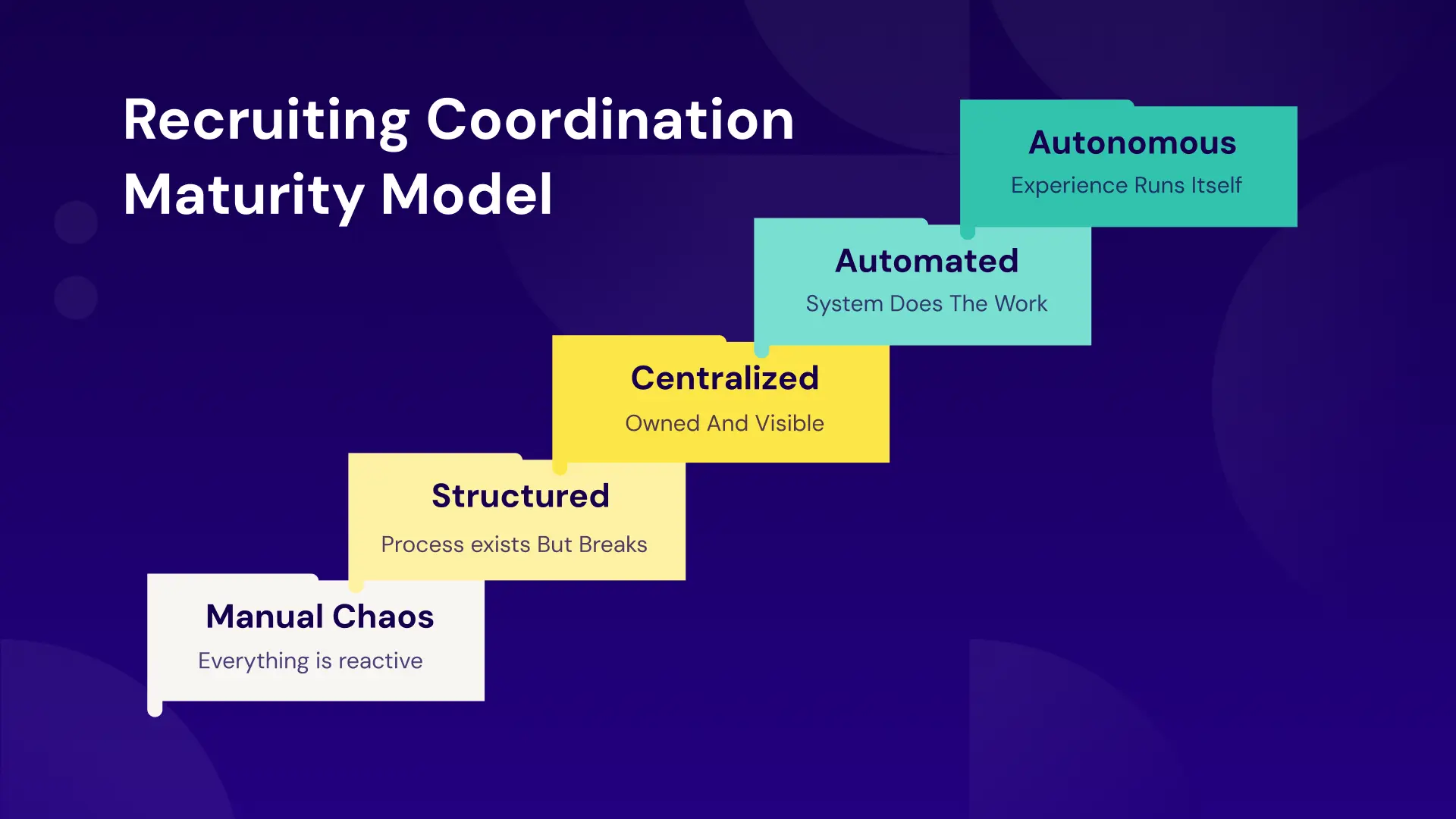
Interview Schedule Optimization: The 5-Level Maturity Model That Determines Hiring Speed
Recruiting teams are struggling with slow interview scheduling, and the problem is maturity of their coordination mindset. This framework introduces five distinct levels of interview schedule optimization, from manual chaos to autonomous coordination.

12 Key Metrics to Track Interview Coordination Efficiency
Want to improve interview scheduling efficiency? Track these 12 key recruiting ops metrics to optimize coordination and candidate experience. Learn more!

AI Agent vs. Chatbot: What the Difference Means for Your Recruiting Team
Most recruiting teams are using chatbots, not AI agents and vendors are blurring the line. Here's how to tell the difference and what it changes in your hiring workflow.