Talent Acquisition Software, Judged on the Interview Stage


Quick answer
Talent acquisition software covers the tools that find, attract, screen, interview and hire candidates. Most buyer's guides judge it on apply flows, CRMs and job boards. Judge it on the interview stage instead: whether it books from a stage change, builds panels, handles reschedules and writes back to your ATS. That is where time to hire is lost.
A TA leader sits through five demos in two weeks. Every vendor opens on the career site. Then the apply flow, the CRM nurture campaign, the job board reach and the AI that ranks applicants. Each demo ends with a candidate moving to the interview stage and a slide that says scheduling is supported.
Nobody shows what happens next. Nobody books a four-person panel across two time zones, has a panelist decline the morning of, and rebuilds the loop. That is the part of hiring the team will live in every week, and it never made it into the evaluation.
Most talent acquisition software lists work the same way. They compare tools on what happens before and at the application, and they stop once a candidate applies. This guide judges talent acquisition software on the stretch between application and offer: does the tool run the interview loop, or does it hand the loop off to a calendar link and a recruiter's inbox?
We build candidate.fyi, an interview coordination platform, so we have a view on that stretch and we say so up front. For the full map of recruiting tools, see recruitment technology, and where AI actually sits in the stack. For a vendor by vendor look at AI tools, see the best AI recruitment tools compared for 2026.
What is talent acquisition software?
Featured snippet
Talent acquisition software is the set of tools a company uses to find, attract, assess and hire candidates. It usually includes an applicant tracking system, a recruiting CRM, sourcing and job distribution, career sites, assessments, interview scheduling and coordination, interview intelligence and onboarding. Most enterprise teams run several of these on top of one ATS.
The term covers a lot of ground, and talent acquisition software companies use it differently. Some mean a full suite. Some mean one layer of it. Sorted by the job each tool does:
* Applicant tracking systems. The system of record for reqs, candidates, stages and offers. Workday Recruiting, Greenhouse, ICIMS, SAP SuccessFactors, SmartRecruiters, Lever and Ashby are the common enterprise names.
* Recruiting CRM and sourcing. Tools that build and nurture talent pools before anyone applies.
* Career sites and job distribution. Where candidates find the role and apply.
* Screening and assessments. Tools that review applications, run tests or conduct first-round AI interviews.
* Interview scheduling and coordination. Tools and agents that book, move and manage interviews, from the first phone screen to the final panel.
* Interview intelligence. Notetakers that record, transcribe and summarize interviews.
* Onboarding. Everything after the signed offer.
An AI talent acquisition platform uses AI agents across several of these layers, rather than adding one AI feature to one of them. And as we covered in talent acquisition vs recruitment, TA is the whole system. The software should be judged on the whole system, not on its first page.
Why most talent acquisition software reviews stop at the application
Featured snippet
Most talent acquisition software reviews compare apply flows, sourcing, CRMs and job board reach because that is where vendors differ most in a demo. The interview stage gets a line that says scheduling is supported. But the interview stage is where candidates wait longest, and where recruiters spend the most manual time.
Read the top-ranking lists of the best talent acquisition software and the criteria repeat: hiring volume, structured hiring, AI governance, integrations, reporting and cost. Interviews show up as a feature line, usually a self-scheduling link or an interview kit. Rescheduling barely shows up at all.
That is backward from where the time goes. Based on candidate.fyi data, scheduling one interview through manual availability requests takes about 243 minutes of back and forth. Our hiring velocity research found that the middle interview stages are the slowest part of the funnel, and that a self-booked interview takes about 4 hours to book against roughly 28 hours for an availability request.
A smoother apply flow saves a candidate a few minutes. An interview loop that books and rebooks itself saves days. If the evaluation never tests the loop, it is tuning the cheap part of the funnel.
Seven tests for talent acquisition software at the interview stage
Featured snippet
Judge talent acquisition software on the interview stage with seven tests: it books from an ATS stage change, builds panels and multi-day loops, handles declines and reschedules, keeps candidates informed between rounds, writes back to the ATS, reports time to interview by stage, and lets admins control what AI does on its own.
1. Who starts the scheduling? When a candidate moves to an interview stage in the ATS, does the tool pick it up and start booking, or does a recruiter open another tab and click? A tool that waits for a person to start it has automated the second step, not the first.
2. Can it build a real loop? A one-on-one phone screen is easy for any tool. Ask for a four-person panel across two time zones, with interviewer pools, load balancing so the same three engineers are not on every loop, and only trained interviewers in each seat. Then ask for a multi-day onsite.
3. What happens when the plan breaks? Declines, no-shows and reschedules are most of coordination. Ask the vendor to have a panelist decline the morning of the interview, live in the demo, and watch what the tool does. Does it rebuild the slot, or email a recruiter?
4. Does the candidate hear from one place? Between rounds, candidates ask about logistics, timing and who they are meeting. Check whether those questions get answered quickly and consistently, or land in five different inboxes.
5. Does it write back to the ATS? Every booking, change and cancellation should show up in your system of record. If it does not, someone keeps two systems in sync by hand, and your reporting is wrong.
6. Can you see the interview stage? You should be able to see time to interview by stage, by req and by team. If you cannot measure where loops stall, you cannot fix them. See the talent acquisition metrics that connect to business outcomes.
7. Who is in control? If the tool uses AI agents, ask how admins set what it does on its own and what it escalates, whether bulk changes need human approval, whether actions are logged, and whether candidates are told when AI is writing to them.
153 Interviews Per Coordinator, Per Week.
The average team manages 38 manually. candidate.fyi's AI coordination layer gives your team 4x the capacity — without adding headcount.
Talent acquisition software platforms, by how far into the interview stage they go
Featured snippet
ATS suites usually cover the interview stage with self-scheduling links and basic panel booking. CRMs, sourcing tools and career sites stop before it. AI screening tools cover the first interview. Dedicated scheduling and coordination platforms like candidate.fyi, GoodTime and ModernLoop run the loop itself, including reschedules, and write back to the ATS.
ATS suites. Workday Recruiting, Greenhouse, ICIMS, SAP SuccessFactors, SmartRecruiters, Lever and Ashby all touch scheduling, usually through self-scheduling links, interview kits and some panel support. They are the right system of record. Depth varies widely once loops get complex, so run tests two and three against your ATS before you assume you need nothing else. Our piece on when your ATS is not built for interview scheduling goes deeper.
Recruiting CRM, sourcing and career sites. Built for the top of the funnel. They fill the pipeline and hand off at the application. Judge them on that, and do not expect them to run interviews.
AI screening and interviewing. Tools that review applications or run first-round AI interviews cover the first conversation well. Most do not run later-round panels. The question is whether a candidate who passes gets booked for the next round without a recruiter stepping in.
Interview scheduling and coordination. This is the category built for the interview stage, and candidate.fyi, GoodTime and ModernLoop are the main enterprise options. They sit on top of the ATS and handle panels, loops, interviewer pools and reschedules. They differ in how many ATS platforms they support, how they handle exceptions and how much they do with AI agents. Our roundup of AI recruiting tools for scheduling compares them.
Interview intelligence. Notetakers record and summarize interviews once they happen. Useful, but they start when the interview starts. The better ones pass notes forward to the next interviewer, which we cover in interview intelligence, and why the notes have to follow the candidate.
Calendar link or interview loop: the question that separates tools
Featured snippet
A calendar link lets a candidate pick a time on one person's calendar. An interview loop needs several interviewers, the right qualifications in each seat, time zones, buffers and a plan for when someone drops. Talent acquisition software that only sends a link hands the hard part back to a recruiter's inbox.
Most TA software can send a self-scheduling link. That covers a recruiter screen well. It stops covering the work as soon as a second interviewer is involved.
Picture a final round for a senior engineer: a hiring manager, two engineers from a pool of eight, a cross-functional partner and a skip-level leader, across Pacific and Eastern time, over two days. A link cannot build that. Someone has to check six calendars, swap in a trained interviewer when one declines, rebook the candidate, update every invite and log it all in the ATS. In most stacks, that someone is a coordinator working from an inbox.
So in every demo, ask one question: when the plan changes, who does the work? If the answer is a person, the tool handled the booking, not the loop.
Where fyi sits on top of the ATS
Featured snippet
fyi is the operator in candidate.fyi. It runs on top of your existing ATS, which stays the system of record, and assigns interview work to agents scoped to a req, stage or team. Teams describe what they want in plain language, in the app or in Slack, instead of configuring settings screens.
We built fyi for the stretch most talent acquisition software hands off. You do not replace your ATS to use it. It reads from and writes back to the ATS you already run.
fyi carries out requests and hands the work to agents:
* Recruiting Coordination Agent. Books, reschedules and rebuilds interviews, including panels and multi-day loops across interviewer pools and time zones.
* Candidate Experience Agent. Answers candidate questions between rounds.
* Interview Companion Agent. Takes interview notes and drafts feedback.
* Application Review Agent. Reviews applications against your hiring criteria and explains each score.
Ask fyi which loops are stalled on a req, or tell it to move every onsite for a team to the following week, and it does the work. Changes that touch many scheduling requests at once need human approval, judgment calls go to your team, and actions are logged. candidate.fyi is SOC 2 Type II compliant.
Teams feel it in capacity. Based on candidate.fyi data, coordinators on candidate.fyi handle about 4x more interviews a week than the enterprise average. See how fyi works.
How to run a talent acquisition software evaluation on the interview stage
Featured snippet
Bring your hardest open req to every demo. Have the vendor move a candidate to the onsite stage, book a four-person panel across time zones, then decline one panelist and move the candidate. Score each tool on the seven tests. The tool that handles the change without a person is the one that saves time.
* Your bottleneck is applicant volume or pipeline. Start with your ATS, CRM and sourcing tools. That is where the usual top-of-funnel lists are useful.
* Screening is fast, but interviews take days to book. Your bottleneck is the interview stage. Look at a coordination layer on top of your ATS, and test it on your hardest loop.
* You are standardized on one ATS suite. Turn on the scheduling it already includes, run the seven tests against it, and add a coordination layer only where it falls short.
* You run high-volume and complex hiring at once. Check that one tool handles both a single phone screen and a multi-day panel, and that the candidate hears from one place either way.
* You want AI agents in the loop. Ask how autonomy is set, what gets escalated and how actions are logged before you ask what the agents can do.
For how agents should share context across these jobs, see why recruiting agents need one brain.
FAQ
What is talent acquisition software?
Talent acquisition software is the set of tools used to find, attract, assess and hire candidates. It typically includes an ATS, a recruiting CRM, sourcing, career sites, assessments, interview scheduling, interview intelligence and onboarding. Most enterprises run several of these connected to one applicant tracking system.
What is the difference between an ATS and talent acquisition software?
An ATS is one part of talent acquisition software: the system of record for reqs, candidates, stages and offers. Talent acquisition software is the wider stack around it, including sourcing, CRM, assessments, scheduling and interview tools. The ATS holds the record. The other tools do specialized work and write back to it.
What is the best talent acquisition software?
The best talent acquisition software depends on where your hiring stalls. If the pipeline is thin, look at CRM and sourcing. If interviews take days to book, look at a coordination layer like candidate.fyi, GoodTime or ModernLoop on top of your ATS. Test every option on your hardest interview loop.
What is an AI talent acquisition platform?
An AI talent acquisition platform uses AI agents to do work across several hiring stages, such as reviewing applications, scheduling and rescheduling interviews, answering candidate questions and taking interview notes. The ones worth buying let admins control what agents do alone, escalate judgment calls and log every action.
Does talent acquisition software include interview scheduling?
Most ATS suites include self-scheduling links and basic panel booking. Fewer handle multi-day loops, interviewer pools, load balancing and reschedules without a recruiter. Dedicated interview scheduling and coordination platforms are built for that work and sit on top of the ATS.
Do I need to replace my ATS to fix interview scheduling?
No. Interview coordination platforms like candidate.fyi run on top of your existing ATS, read candidate and stage data from it and write bookings back. Your ATS stays the system of record. Replacing an ATS is a much larger project, and it rarely fixes scheduling on its own.
The bottom line
Talent acquisition software is usually bought on its first page: the career site, the apply flow, the CRM. Hiring is won or lost later, in the interview stage, where candidates wait and coordinators do the most manual work. Judge every tool on what happens between application and offer.
That stretch is what fyi is built for. Book a demo and we will run fyi on one of your real interview loops, panel and time zones included.
More Articles
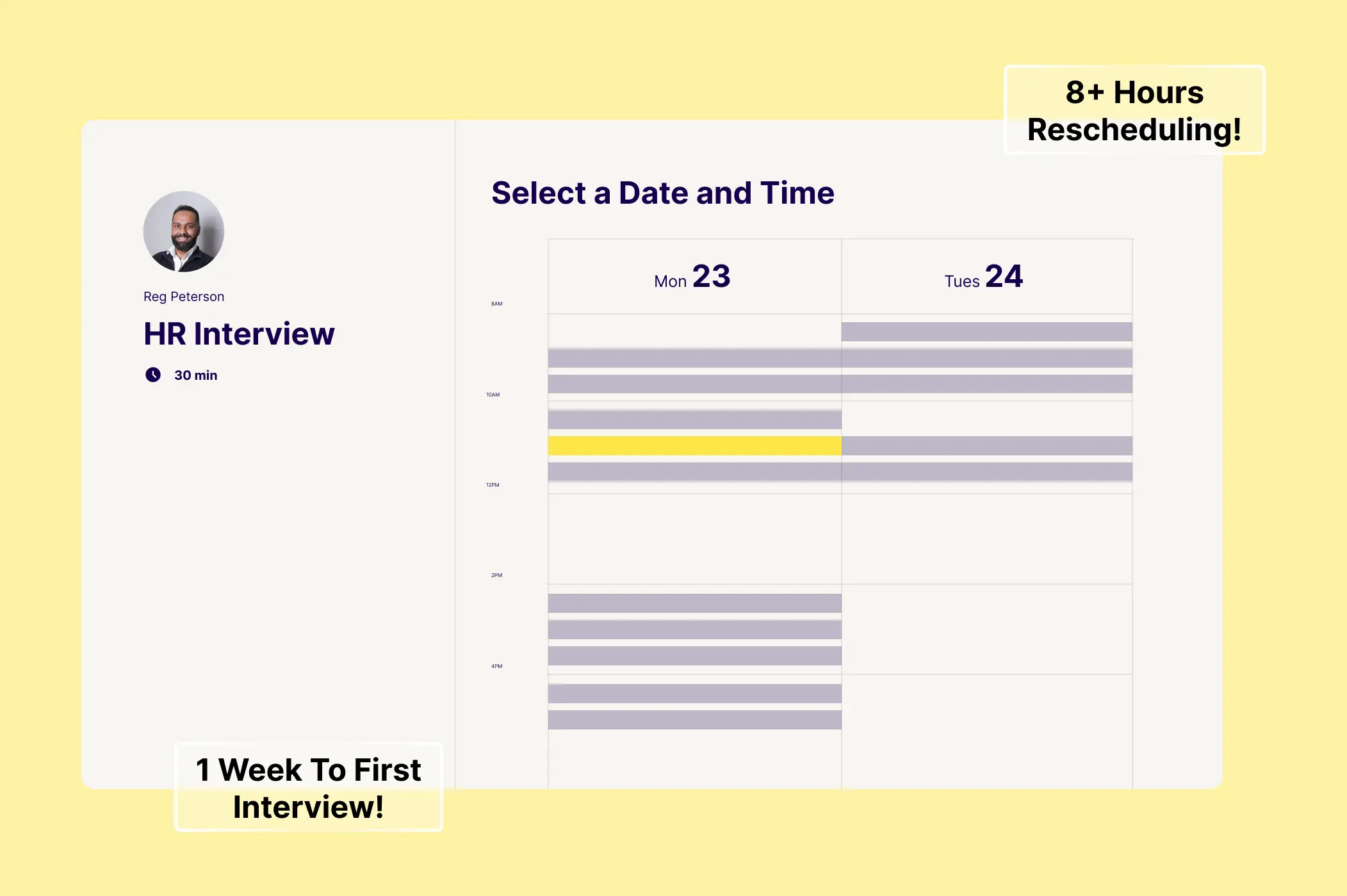
Is Calendly a Good Enterprise Interview Scheduling Tool? (Here’s Why the Answer Is No)
Calendly is great for individuals, but it fails enterprise interview scheduling. See why it breaks at scale, where it falls short, and how AI-powered options win.
Time to Hire: The Coordination Tax (and How to Cut It)
Time to hire measures how fast your pipeline moves once a real candidate is in it — and most of the days go to coordination, not evaluation. Where the time goes, what a good 2026 benchmark looks like, and how to compress the delay between stages without lowering the bar.
What Is a Candidate Experience Platform?
Candidate experience platform is not a category any analyst tracks, so the label means whatever the vendor selling it means. Here is what the products actually contain, where the ATS stops, and the five questions that separate a coordination system from a booking link.